Showing posts with label Heirlooms. Show all posts

Tuesday, January 28, 2025

A Castle, A Clan, and A Connection

Jim and Lynn at Urquhart Castle c. 1989

Sometimes a place calls us to it and we don’t learn for decades later why! 

For me, the place is Urquhart Castle on Loch Ness, close to Inverness Scotland. In 1988-89, my boyfriend (now husband), Jim and I studied our junior year abroad at the University of Aberdeen in Scotland. In addition to our travels to Europe during winter break and around the UK during spring recess, we took day trips and long weekends organized by the exchange program. At least twice that year, we visited Urquhart Castle. I’m sure that the infamous Loch Ness was one reason, but a love of castles was another. 


The Castle


Urquhart Castle, like most castles in the UK, has a long and storied past. For those interested, please visit the official historic website. There are many beautiful photographs of the location, far better than my (over) 35 year old digitized photos can provide!


Sometime after we were married, we happened upon a vintage image of what we thought was Urquhart Castle. I think we found it on our trip back to Scotland in 1999. We didn’t get that far north on that trip to Scotland but we must have picked it up on our travels. We liked it enough to have it framed and it has been hanging prominently in our house on a kitchen wall for decades. In researching for this blog, I learned that the image is actually a copy of a vintage engraving from 1895 printed in a book called Souvenir of Scotland: Its Cities, Lakes, and Mountains One Hundred and Twenty Chomo Views. Who knew?!


The Clan


There was also a clan named Urquhart who resided in the region. Both Urquhart Castle and the Clan Urquart were named for the Celtic word “Airchart”, which is a region now called Cromarty, just about 25 miles north of Inverness. The research that I read suggests that the Clan Urquart was not affiliated with Urquhart Castle, they were both just named after Airchart. So maybe it was more of a draw to the area and not really the castle?


The Connection


About 10 years ago as I was investigating my great-grandmother (Cora Viola Orcutt–the one whose Irises I have in my yard), I learned that the name Orcutt is a version of Urquhart that shows up in America. My great-aunt, Helen Tubbs Judson (my genealogy angel), researched the Orcutt Family and identified who she thought was the immigrant. That was William Orcutt (1618-1693) and his wife Mary Lane (1646-1693). There is some question about Mary, as it seems he might have had more than one wife and possibly more than one wife named Mary. There is documentation, though, that they had a son named William in 1664 in Bridgewater, Plymouth, Massachusetts, where William died. William Orcutt was born in Fillongley, North Warwickshire Borough, Warwickshire, England. In some information I found, it appears that there were Orcutt’s who migrated to England before heading to the “new world”.


Why now?


Why did I have a renewed interest in Urquhart Castle and the Clan Urquhart? Well, as I was investigating lineage societies recently, I came across Clan Urquhart Association, a lineage society open to anyone who can trace their name back to an Urquhart, Orcutt (as well as Cromartie and Cromarty)! The one-time fee of $20 would get me a membership card, two newsletters a year, and invitations to international gatherings of the Clan. The organization was established in 1976 to help promote awareness and preserve the history and heritage of the Clan. There is still also a Chief of the Clan. I haven’t decided if I am going to try to join, but I may invest in some article of clothing with the Clan’s tartan, which I find quite appealing! And just maybe I will wear it sometime when I’m back in Scotland and visit my family’s long ago homeland near Urquhart Castle?


Saturday, November 16, 2024

The Mysteriously Appearing China


My grandparents, Roc and Dot Massey,
and my parents at my parents'
wedding reception, 1962
As care takers of the family heirlooms, Jim and I have an old house full of fun and interesting things. Much of it we know who it originally belonged to and how it came to be in our possession. It’s important, though, as we are blending so many families’ things that we catalog it for future generations. I listened to
Lisa Louise Cooke podcasts sharing the importance of a genealogy will, in order to describe heirlooms and make sure that treasures get to the right people. If we don’t document the stories and provenance, it will be more likely that things end up being donated or even worse, in a dumpster.


Most of our treasures came from my mother’s mother’s mother’s side of the family, but some came from my father’s and husband’s families. My mom happens to be the only child of the youngest child (Elizabeth Leach) of the youngest child (Florence Stoddard). (Interestingly, I have no known family heirlooms from my mother’s father’s side, except for a few photos.) I’m not sure which is more important (birth order or gender) for the passing down of heirlooms but since I am the youngest and a daughter it was doubly certain we would receive many of the treasures! 


Our China Cabinets

This past summer, I spent time investigating and cataloging china that came from my father’s parents. My grandparents, Rockwell Joseph Massey (born Rocco Mazziotti) and Dorothy Sedlock, were married on the 9th of February 1934 (the 26th wedding anniversary date of his parents). Given that it was the midst of the depression and they were both 1st generation Americans, I’m not sure how prevalent it was to register for/choose a china pattern. (It seems widely accepted that the Chicago-based department store Marshall Field’s established the first bridal registry service in 1924, so it would have been possible in 1934.)


My Grandparents’ China


My father remembers china displayed in a built-in china cabinet in his childhood home in Ridgewood, NJ between 1940-1950. But when the family moved to Michigan (he was about 10 at the time), he never remembers it being used or even displayed. There apparently was no place in either of their homes in Dearborn, Michigan to display it, so it remained for over 40 years in “barrels” in their basement. My grandfather traveled for work (he became a Regional Manager for the GM Training Centers) and my grandmother didn’t entertain often once they  moved to Michigan so there wasn’t much need for using the china. I remember hearing about china in the basement as a kid visiting their house, but I don’t think I ever saw it.


In the 1990s, my grandparents passed away, my parents retired and downsized, and Jim and I were married, so in the late 1990s we became the caretakers for their china. In 2002, when we moved into our present house (built in 1896) we had an entire wall of built-in shelving in our dining room perfect for all of the china! It’s not a mystery how WE came to possess the china, but how it came to my grandparents is a mystery to my dad and me! 


Was it my grandparents' wedding china? Was it passed down from my grandmother’s parents’ wedding china…she was the youngest? Or was it just purchased at yard sales/resale shops up by my grandfather to fill the china cabinet in their Ridgewood house and really has no sentimental value? But if this was the case, then why wouldn’t they just have gotten rid of it when they didn’t have the room? Maybe some investigation into the actual china might help?


Beginning the Investigation


The interesting thing about all of my grandparents' china is there is not a complete set of anything! There are bits and bobs from 7 different sets. Some look fairly similar but others are very different. One set has 11 plates and a serving bowl, another is just 4 cups, 5 saucers and 6 lunch plates, another has 13 small plates, 11cups/12 saucers–you get the idea. As a kid, I had heard people (mostly my mom and grandfather) oohing and aahing about “Limoges” china. I really didn’t know what it meant until this summer. 
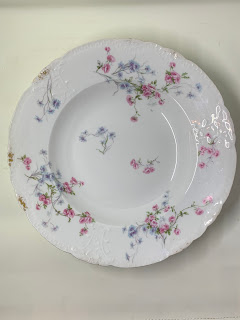

Limoges China


I had thought that Limoges was the name of a company that made china. No, it is the name of a town in France close to the abundant kaolin mines, out of which comes the special white clay used to make the hard paste-porcelain. “Porcelain Limoges is famous for its durability, whiteness, and ability to resist chipping” (limogesboutique.com) and you know it’s real if you can nearly see through it when you hold it up to the light. 


There were many companies that used Limoges, but the most famous companies were Haviland & Co, Theodore Haviland, and Charles Haviland. The Haviland Company history began in 1840 with David Haviland who had a china shop in New York City and established an alliance with a manufacturer in France who would specifically make the pieces for America. In 1853, he established his own company and was the first to have artists on site to do the decorating. His sons went on to develop their own companies. Theodore Haviland was apparently known as an innovative marketer and his goal was to have “a set in every home” and in the 1920s, the Sears Catalog had 32-piece sets for $22.50 (about $412 in today’s money). (From History of Haviland).


“Our” China


Out of the 7 different sets, three are Haviland & Co. and two are Theodore Haviland brands (the 6th and 7th are Zeh Scherzer from Bavaria). I wondered if/how I might be able to identify the patterns and maybe narrow down the timing for when they were produced. I’ve written a couple blogs about some family heirlooms, like my great-great-grandfather’s gift of a pocket watch to my great-great-grandmother, my great-grandmother’s irises, Jim’s great-great grandfather’s trinket, and Jim’s father’s treasured toy car. In each of these cases, I learned a lot and found that there is a collector’s organization for nearly everything! Haviland China is no different!


There is a Haviland Collectors International Foundation (HCIF) dedicated to the study of porcelain and pottery produced by the Haviland companies. They have a newsletter and even an annual conference! They do also have an identification service, but I thought I would try my hand at it. The HCIF does have a very handy guide to Haviland Blank and Decorator Marks. 
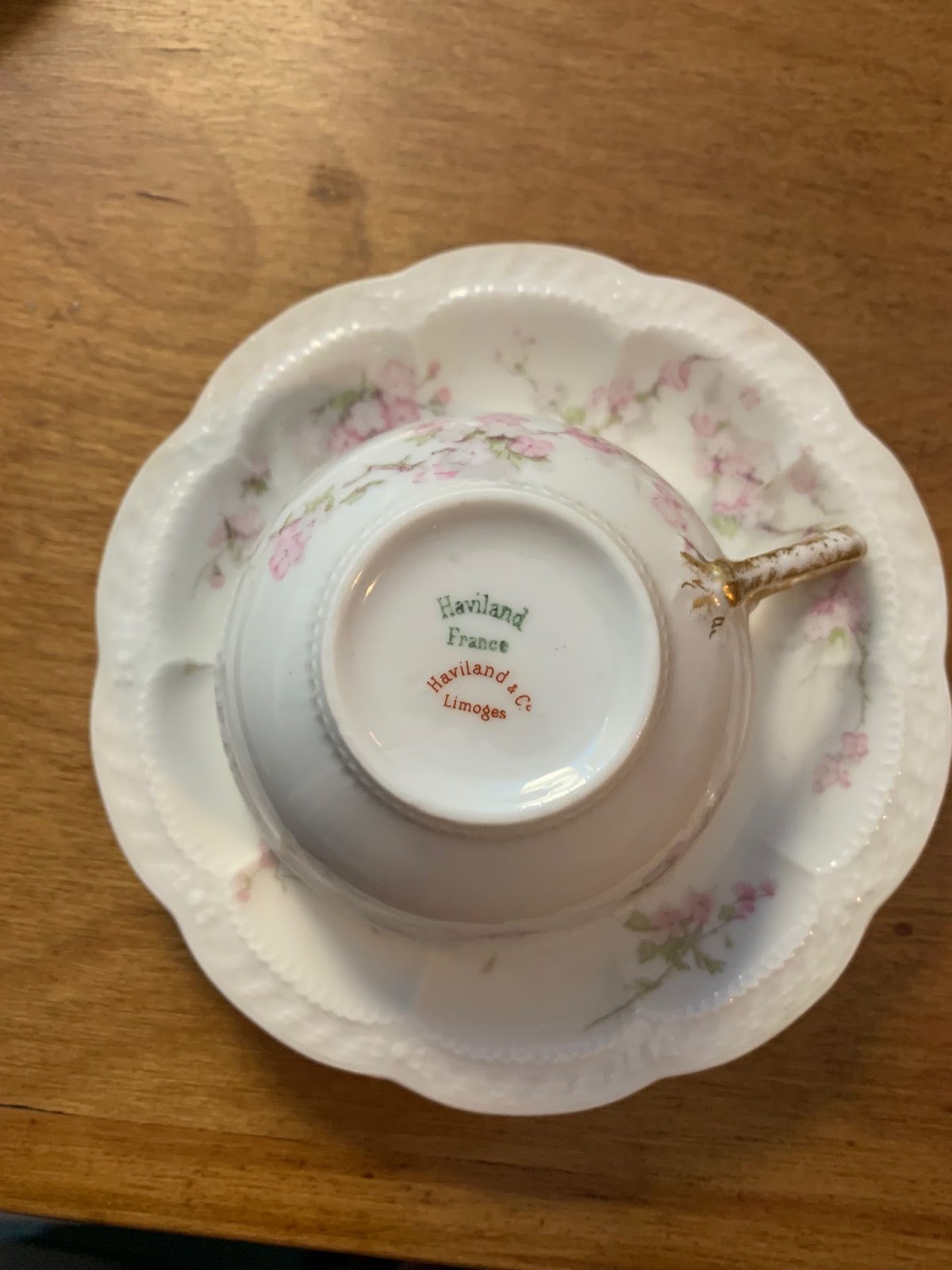

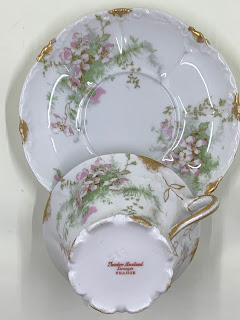
What is a blank? That was new to me, too! The blank is what they call the porcelain item before it’s been fired and painted. Some blanks are plain, but others have a pattern and the size and shapes differ and help to determine the specific pattern. Looking at this photo, this blank is quite decorative, with the scalloped edges and it might be hard to tell, but that shadowed pattern is actually a raised pattern around the edge and into the plate to make it look like petals. 


There are two sets of marks (this was not a mistake!), there are marks that are made prior to glazing and then marks made by the decorator after the glazing. You can see here on this cup the green underglaze mark, which is Mark I that was used between 1894-1931 and the red decorator mark, which is Mark c, used 1876-1878/1889-1931. So we’ve narrowed to 1894-1931. Can the flower pattern help us at all in the identification?


Schleiger Numbers


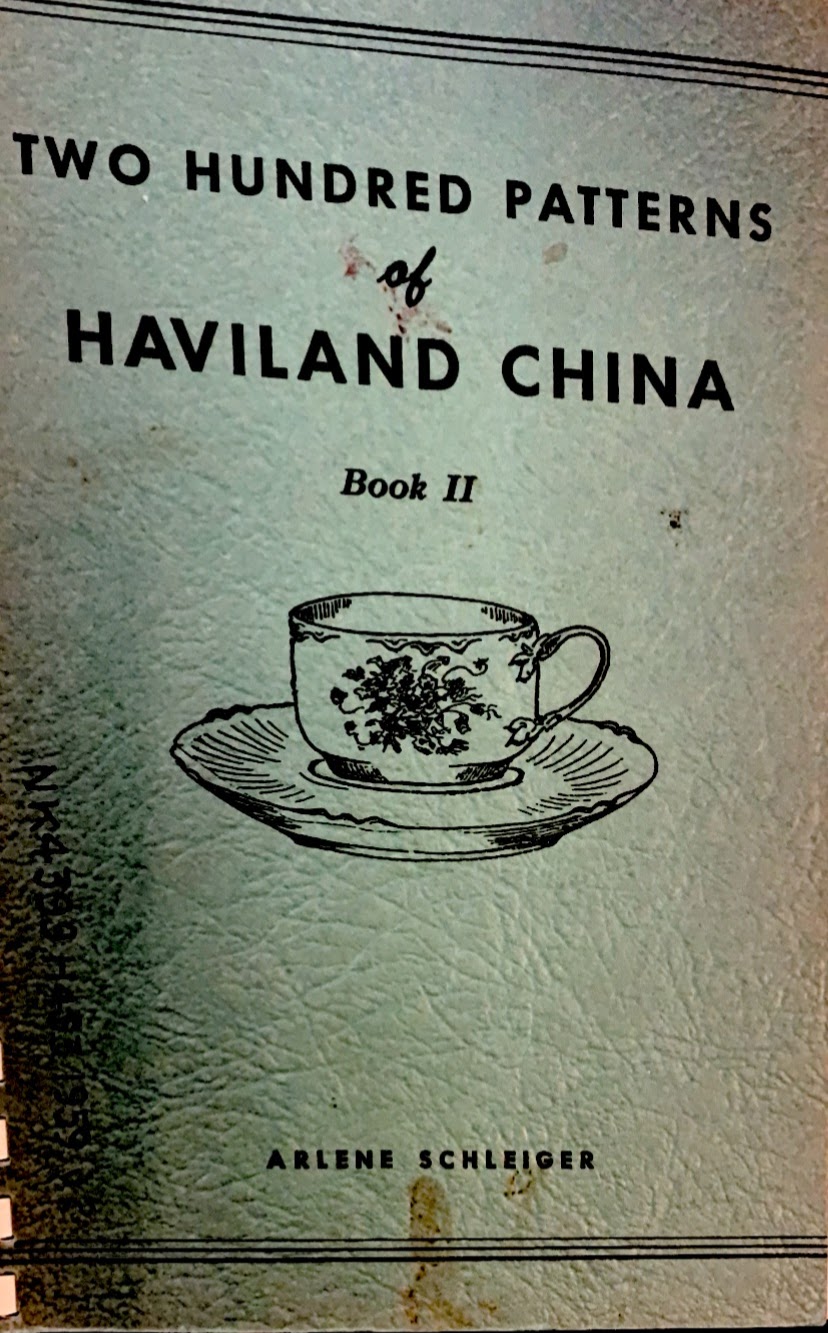
It turns out that there are estimated to be over 30,000 different Haviland China patterns created by the 1930’s and most did not have a name and very few even had a number. According to the A Pattern Identification Guide for Haviland China: Volume Two by Gertrude Tatnall Jacobson (1979) only 725 of the patterns had a name. These 30,000, though, are just variations and combinations of blanks, flower patterns, and use of gold/silver trim. Because there was no easy way to catalog these, an amazing collector, Arlene Schleiger, decided to try to do it. She, with the help of her talented architect son, provided hand drawings and descriptions for nearly 11,000 of these patterns. She produced 6 volumes of these amazing books beginning in 1950 through 1991. One amazing benefit of working at a university is the library collection. It turns out that my university had the first 4 volumes of her books!! Unbelievable luck!


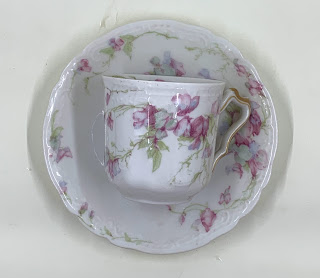
Using her guide, I was able to identify one of the 4 sets. It is a Theodore Haviland set BL 205 (blank #205) Pattern # 248, described “Small pale pink flowers touched with white. Some all white. Green leaves and stems. Gray shadows around flower groups.” (p. 48, Volume II) An additional investigation into the mark suggested S, 1903. (https://archive.org/details/havilandchinavol00gert/page/157/mode/2up?view=theater). 
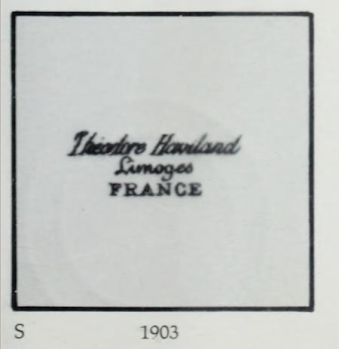
Unfortunately, I couldn't find the other 3.


Replacement, Ltd.

I contemplated joining the HCIF, but thought I would try one other source recommended by the organization. Have you ever broken, chipped, or lost a piece of your everyday plates or your fine china or crystal or sterling and found that it was discontinued? But you really wanted to replace the piece? Well, there is an organization that began in 1981 called..you guessed it…Replacements, Ltd that went into business collecting and distributing replacement pieces. You need to know your manufacturer and then pattern name to really be successful, but once you do their search engine brings up a photo of your item. For example, our everyday plates we chose before our wedding in 1990 are the Poetry pattern from Pfaltzgraf. It was long-since discontinued but if we wanted to, we could replace all of them!


Although I could have paged through all of the Haviland patterns it would have taken weeks! Instead I ordered from Replacements, Ltd the book Haviland: A Pattern Identification Guide (no, our library didn’t have this one, so I invested in the book–I was hooked now). This 577-page book includes photos, pattern names for those that had names,  the Schleiger #s and Blank #s. After pouring over the china and the book for just 3 days, I was able to identify two of the other patterns! 


So, whose were they?


I am now asking myself, what did this GIANT rabbit hole (and huge investment of time and money) gain me? Am I any closer at figuring out whose they were and how they came to be with my grandparents?


Well, given the Theo Haviland patterns were around 1903 (based on the mark), I am pretty convinced that none of these were wedding china for my grandparents…and I have no idea whose they were…I’m leaning toward the theory that my grandfather just picked up them random places to make the china cabinet look pretty.


But…


Remember how I said that 5 patterns were Haviland and the 6th and 7th was Zeh Scherzer? Well, using my skills in porcelain developed through investigating the Haviland patterns, I think I figured out who these sets might have belonged to. 


Zeh Scherzer (Z S & Co) was a porcelain producing company located in Bavaria, Germany that began in 1880. Their marks changed over the years and the mark that we see on our china was used from 1899-1910. I haven’t found the exact patterns (there doesn’t seem to be a collector’s club for this china) but given the timing, I would say that this was perfect timing for my great-grandparents Alonzo Sedlock and Louisa Hillman who were married 18 May 1904. Louisa’s parents were both from German families, her father (Johann Willheim Hillman) immigrating in 1879 from Bremen, Germany and her mother (Emma Amanda Sackman) was born in Germania, Potter County, Pennsylvania but her older siblings were born in Hamburg, Germany (Emma was my last week’s post.). According to newspaper accounts of Louisa in the social columns, she was a socialite and it would not be surprising to me that they were given china for their wedding. 


So, I am going out on a limb and conjecture that the 11 plates and 4 cups/saucers and 6 small plates were gifts to Alonzo and Louisa Sedlock for their wedding.


We probably won’t ever know the real story of this mysteriously appearing china but for as long as we own our current house, it’s a beautiful addition to the shelves and I don’t mind using the china for entertaining. In fact, this past weekend, I used several platters for our DAR Special Tea!

Monday, November 4, 2024

Treasured Toy Car


Bill Breyfogle, c. 1938
color enhanced by myHeritage
My father-in-law (Bill) recently shared some of his boyhood treasures with my husband. This week as I was unpacking one of the boxes, I came across this well worn toy car. Not having any idea about its provenance, I asked my husband. He said that this was a toy car that his dad had been given when he was a little boy from a “cousin”.


I uploaded one of the photos and using Google Lens found an eBay result below that helped identify at least a manufacturer and era for it. I was curious to hear a little more about the story, so I called my father-in-law.


He was delighted that I was interested and shared with me that he remembered meeting the person who was the original owner and he thought he was about the age of his 1st cousins, Joe and JC DeBoer (so born around 1919) and he also knew the sad fact that this man served in WW2 but didn’t return. He wasn’t sure how he was related and it might even have been cousins of his cousins and it might have been his cousin’s mother’s side. In answering questions, he shared with me that the car is pretty much as he remembers receiving it, without the back license plate or spare tire and the painting of the silver was done before he received it.


The Original Owner


I love a good mystery, so I spent some time delving into my father-in-law’s family tree looking for a man who would have been a boy in the 1920s, who would have been able to enjoy a toy car like this around 1927 and served and died in WW2. At first I thought this was going to be easy, how many people could this be?


Since Bill said it wasn’t a 1st cousin (he actually only has 2 on the DeBoer side–Joe and JC) and thought it was related to their mother’s side, I looked into her. Since she married into the family, I hadn’t done much work on her line and it was all new. She was born Johanna “Anna” Smith on 5 June 1894 to

Anna and Joseph DeBoer
c. 1915
Earl Kyse Smith (1865-1900) and Grietje Hermans “Maggie” Van Bloois (1869-1951). Earl was married before Maggie, his first wife died shortly after the birth of their first child. Anna’s father, Earl, died when she was around 6 and with 4 children under 10, and Earl’s one just a little bit older it was not surprising that her mother, Maggie remarried quickly. She married John Stouten (1869-1950) and they had 2 more children together and he brought 5 children into the marriage from his first wife who also died. Not knowing if the original owner of the toy car might be a step-sibling, I felt I needed to investigate all 11 possibilities, which meant finding all of their spouses and children. After an exhaustive search, I found 1 man who died in Pearl Harbor, James Stouten (1901-1941), the son of John Stouten and his first wife. This didn’t seem right because he wasn't a child in 1927 and didn’t match being born in the 1919 timeframe. I looked for a son of James, but couldn’t find any indication he had children.


William and Eva Van Dam DeBoer Family
c. 1911

William and twin Martin
DeBoer c. 1880


So on to the possibility of 2nd cousins, which means investigating the families of siblings of Bill’s grandparents. His grandfather was William Joost (Joseph) DeBoer, a twin with Marinus (Martin) DeBoer born on 5 Oct 1871 in Grand Rapids, Michigan, and they were #4 and 5 of 11 children. Whew! That’s a lot of kids to check out, but fortunately most of them I had already researched. This exhaustive research brought no possibilities! 


On to Bill’s grandmother, Aafke (Eva) Van Dam born 24 September 1871, also in Grand Rapids, Michigan. (Unsurprisingly, they attended the same Dutch Reformed Church in Grand Rapids). Eva was the 2nd of 10 children! Let’s hope that each child didn’t have 10 children! Again, I had researched many of her siblings, so it didn’t take me long to find a likely candidate. The 5th child, Harmon Van Dam (1881-1954) and his wife Dorothy Froman (1893-1965) had 6 children (3 boys and 3 girls). The youngest of these boys was Peter Charles Van Dam born 1922 and served as a Tordepoman’s Mate Second Class aboard the submarine, the SS Kete. According to the

Naval History and Heritage Command, the Kete departed “Guam on 1 March 1945 headed for her second patrol in the vicinity of Nansei Shoto. In addition to performing a normal patrol, Kete had orders to submit special weather reports, and to carry out rescue service during an air strike by carrier based planes.” After firing some of their torpedoes on a small enemy cable laying vessel, they were directed to depart the area on 20 March and proceed to Pearl Harbor. They sent their last update on 20 March. They should have arrived to Midway (a refueling stop) by the 31st of March but never made it.


Here is the Obituary of Peter C. Van Dam published in the Grand Rapids Press on April 13, 1946. I am fairly certain that Peter was the original owner, or at least the boy who passed it along to my father-in-law, Bill.


More about the Toy Car


We don’t know exactly when Peter handed down his toy car, but it would have been well before he left for the Navy, since little Billy would have enjoyed it in the late 1930’s, when Peter was in high school. 


I did some more investigation on the car, which led me to the Antique Toy Collectors of America. (Are you surprised there is a club for this? I am no longer surprised since it seems like there is a club for everything!) Their website provides a plethora of information including the 1926 and 1931 catalogs for the Kingsbury Manufacturing Co. Another website called Pressed Steel & Metal Toys of the 1920s & 1930s provided some added photos and background of the Kingsbury toy company (but none of the exact car). Little Billy’s car does not appear in 1926 catalog but a version of it appears for sale in 1931 for $3. (Adjusted for inflation that would be $69.72 in today’s money).


The No. 340 Cabriolet is advertised as “A perfect reproduction of the artistic models seen on Fifth Ave. Finished blue with orange striping and wheels. Rubber tires and motor.” I’m thinking that earlier models were in green but the orange striping, rubber tires, and a wind up motor are still present. 


There appears to be a market for these antique toy cars (it is nearly 100 years old!), but my husband has no desire to give it up, especially now knowing its provenance!


Sunday, April 7, 2024

Inspiration in Surprising Places


Bertha "Birdie" Elizabeth DeBoer
(Enhanced by MyHeritage)
Nearly a year ago, I wrote about my great-aunt, Helen (Tubbs) Judson, my genealogy angel providing so much insight and research on the Tubbs and Orcutt families. The Orcutt family, my great-grandmother Cora (Orcutt) Tubbs’ line is the one that takes me back to the Mayflower.

Today, I would like to share about a different type of genealogy angel who provides me (and hopefully you) with inspiration. This is Bertha “Birdie” Elizabeth (DeBoer) Breyfogle, my husband’s paternal grandmother. I never had the pleasure of meeting Birdie, she passed away our freshman year in college. All four of Birdie’s grandparents emigrated from the Netherlands to the United States in the 1850s & 1860’s and settled in Grand Rapids, Michigan. Her mother Aafke (Eva) Van Dam born in 1871 was the 2nd oldest of 10 children and her father William DeBoer also born in 1871 was a twin (definitely not identical!) and the 4th/5th of 11 children. Family, the Dutch Reformed Church, the United States, and education were extremely important to them. Bertha was born in 1901 and the youngest of 4, with 3 older brothers. Her three brothers all served in World War 1 and ended up in careers in various government agencies. She was a woman ahead of her time and given opportunities that a lot of contemporary women were not offered. She was given the opportunity to attend Olivet College and transferred to the University of Michigan to finish her Bachelors and also Master’s degree.

William DeBoer & Eva Van Dam Family
c. 1911 (Enhanced by MyHeritage)


Women & College


Women might be inspired by her being among a small number of women earning a bachelor’s degree ’22 and also a master’s degree before 1925. Just imagine, when she graduated from high school and began college it was 1918 and women didn’t have the right to vote! 


I was curious, how unique was it that she was attending college in the late 1910s and 1920s? In investigating how many women were graduating from high school and college, I came across some very interesting and enlightening statistics. According to the National Center for Education Statistics, in a table that collected the percentage of persons 25 to 29 years old with selected levels of educational attainment by race/ethnicity and sex (estimated from census data): 

  • Bertha DeBoer 
    University of MI Diplomas
    in 1920, 22% of White and 6.3% of Black people completed high school,

  • Also in 1920, 4.5% of White and 1.2% of Black people earned at least a Bachelor’s degree. 

  • For comparison, in 2013, 40.4% of White and 20.5% of Black people earned a bachelors or higher. 

What was striking to me was the ratio of men to women. I had always assumed that women were significantly underrepresented in college, like 5-10% of the people in college were women. It turns out that in 1920, 47% of the people in higher education were women! (We won't, however, talk about what they were welcomed to study!) So while it is true that a very small percentage of White women were in college in the 1920’s, it wasn’t that they were women, rather so few people, overall, were college-attending. After 1920, the number of college attendees began growing but the number of men outpaced women, so women's attendance did fall to 40% of the total college-attendees by 1930 and 30% in 1940 but unsurprisingly in 1944 it surged to 50% and the women have (for the most part) kept pace or exceeded the college attendance.

Birdie as a young woman
c. 1920s


Birdie’s Inspiration


Additionally, I am inspired by Birdie’s record keeping! As I peruse her scrapbooks of her time in college, I am in awe of the meticulously detailed notes that she kept, especially of photos. I am sure that I would have loved knowing Birdie and we would have gotten along famously well and might have even scrapbooked together! My scrapbooking friends always make fun of me for my need and desire to “journal” on the scrapbook pages. (For those not familiar with scrapbooking, journaling is the text that you put on a page to help conjure up memories from the event or highlight the importance for the viewer.) But Birdie is my hero and inspiration!


As I flip through pages of her sorority and musical events, I am getting a sense of some of the social things she engaged in and what college would have been like for her and other people at the time. Here’s an example. She became a member of the Sigma Beta Society at Olivet College (it still exists today at University of Olivet-yes, name changed this past year!), this is the same college that my great-grandparents, Florence Stoddard and Edward Leach, attended and met at in 1903 (yes, funny coincidence!). 


Birdie's Scrapbook Page 
Billboard Advertisement for the silent film (1920)


Sigma Beta’s held an “Annual Public”, which appears to be a night of performance. I’m  not sure if Birdie was the photographer (I’m guessing so), but she had two photos of the scene/performers along with the program. The performance was a stage adaptation of the book “Old Lady Number 31” (1909) by Louise Forsslund (Mary Louise Foster) and made into a Broadway Play in 1916-1917 and a silent film starring Emma Dunn released 20 April 1920. Birdie included on the back the names of all of the women in the photo. I’m not sure why, though, that she wrote at the top “Old man 33” at the top of the back of the photo. I was confused, was this a different play, a spoof on the one that they were actually doing? I compared the photo with the program and indeed all of the people seem to be the same as the program. Was this just an inside joke? I’m not sure that I will ever know, but what I do know is the names of every person in the photo and the parts they were playing! I can’t say the same about most of my photos. 
"Old Lady Number 31"
Sigma Beta, April 1919

What I am so inspired by is the way that on EVERY photo, she identifies (almost always!) every person in the photo! I recognize that they took much fewer photos back then, but she always included as much as she could remember and that can’t be said about the thousands of photos I see in flea markets.


We probably all have thousands (if not tens of thousands) of photos with few of them identified. I, for one, am trying to make it a habit to enter in a title or description and name (tag) the faces in my electronic files. Maybe not all of them, but the special ones you upload into MyHeritage or Ancestry or some other format and the ones that shouldn’t ever be deleted!


I hope Birdie inspires you, too, so that all of your great photos don’t end up in the trash by some relative who hasn't a clue of who is in the photos or at a flea market with no prospect of being picked up my someone like me looking to reconnect them with possible descendants!


America250-Revolutionary War Patriots --#6--Lt. Caleb Hopkins

Jim’s 5th great-grandfather, Lt. Caleb E. Hopkins (1749-1824) DAR (#A047932) served as a Lieutenant Revolutionary War Patriot.  He was the s...