Today is Thanksgiving, November 28, 2024 and it would have also been the 110th birthday of my grandmother, Elizabeth Anna Leach Tubbs. A woman I am so very thankful was a part of the first 30 years of my life! So today’s blog is dedicated to her.

Early Life
 |
| Clay, Florence, and Elizabeth |
Elizabeth Anna Leach was born on November 28, 1914, in Hancock, Michigan, the third and youngest child of Edward James Leach and Florence Mary Stoddard. Her mother always called her Elizabeth, but I heard most people call her Betty or “Tibby”, but the second nickname comes after meeting my grandfather. Betty faced the early loss of her father at just five years old. Despite this hardship, she grew up with a strong spirit, spending her formative years in Michigan, particularly in Reed City with her mother, brother, and grandparents while her mother secured her teaching certificate and then later in Ypsilanti when her mother found an elementary school teaching position. Her early life set the foundation for her unyielding perseverance and adaptability.
Betty’s mother never remarried and I think was an incredible model of female independence and fortitude for her. Although my grandmother was married for nearly 60 years when my grandfather died, she was an independent woman and raised her daughter (my mother), and taught my sister and I to be independent, developing our own careers so that we could live without a spouse. “Mary Lynn”, she would say, “you never want to be dependent on a man!”
 |
| 1937 Wedding |
In 1935, Betty and Walter Elliot Tubbs (called “Tubby” by friends) eloped and two years later in 1937 they had a beautiful wedding that made her mother happy. (I wrote about that in The Amazing Power of Newspaper: Part 3). I don’t know if this is true for my grandparents, but my Uncle Clay (Betty’s brother) and Aunt Vivian also eloped in the 1930’s and they always said it was because during the deep depression married women were not allowed to hold a teaching position, so they eloped and lived apart for a while.It’s only speculation, but I believe that my grandparents met at Michigan Normal School (now Eastern Michigan University). Betty’s older brother, Clay, was also at Michigan Normal School and I believe knew Tubby first. The story of how Betty and Tubby met is forever lost, along with exactly why they chose to elope, and who Betty was originally engaged to before meeting my grandfather! We only know that she broke off her engagement!
Early Married Life
Tubby’s father and older brother (11 years older!) served in World War 1 (actually in the same unit!) and his brother made a career of the military, so it was not surprising that Tubby would too. He started in the National Guard and did two terms before joining the Army. By 1941 he was promoted to Lieutenant and stationed in Louisiana, which is where my mother Mary Anne Tubbs was born in December 1941. She is the only child of Betty and Tubby and although more would have been welcomed, it was not to be.
 During the war years, Betty and little Mary Anne were back in Michigan, where Betty could work and live close to her mother and in-laws. I have been told (but I haven’t yet been able to confirm it) that Betty worked at the Ford Motor Company Willow Run Bomber Plant in Ypsilanti during these years. Some sources say that 12,000 women were hired and they were paid the same rate as men ($0.85/hr) in one of two nine hour shifts a day. This is the plant that prompted the Rosie the Riveter campaign. At their peak production they were making a B-24 every HOUR! (sources: Willow Run | Detroit Historical Society and How Ford's Willow Run Assembly Plant Helped Win World War II | 2019-01-03)
If this was true, I know it would have been at least her 2nd foray into factory line work. She told me the story that when she was younger (I’m assuming teenage summer work), that she lived with her grandparents in Reed City and worked at a cherry canning plant. She described working on a line with a chute as cherries were hurtling past. The workers were supposed to pluck out the rotten or wormy cherries and place them along the edge. As a result of working there she NEVER EVER bought a can of cherry pie filling or any canned cherries because she KNEW how many rotten cherries went past her. For anyone who ever watched the I Love Lucy show, remember the iconic episode of Lucy and Ethel in the chocolate factory? Yeah, that’s what I imagined as my grandmother was telling me the story…except I’m sure she was not popping the cherries into her mouth!
 |
| Credits: Vachon, J., photographer. (1940) Untitled photo, possibly related to:
Migrant girls working in cherry canning plant, Berrien County, Mich.
United States Michigan Berrien County, 1940.
[July] [Photograph] Retrieved from the Library of Congress,
https://www.loc.gov/item/2017720609/. |
Beside working and taking care of young Mary Anne and doting on her mother who was also working, she was the consummate hostess in various societies. Both she and her mother were members of the Ypsilanti DAR chapter and I have numerous newspaper articles identifying Betty as the hostess or meeting presider during the years immediately before the war and then again right after.
Middle Married Years
 After WW2 ended, life changed dramatically for this young family. My grandfather was stationed first in Japan from 1946-1949, so the whole family moved and lived there with him. My grandfather was making the military a career and moving up the ranks. My grandmother became an Army Officer Wife and learned to live this part. My grandparents became known as Tubby and Tibby, my grandfather earning his name because he was always a little portly and my grandmother maintained a thinner figure. My mother tells me that this period in their life was pretty “cushy” with a maid and cook and my grandmother playing bridge and entertaining other officer wives. My parents entertained a lot as I was growing up and they were spectacular hosts! As I reflect back on it, I’m sure it was my grandmother’s influence and model for my mom.
 |
| The two Tubbs brothers. |
My grandmother, too, was an excellent hostess and having “everything just right” was important. For example, the ketchup (she called it “catsup”) bottle could never be put on the table, it must be served in a bowl with a spoon and there were always many condiments (for any meal) like pickles of various varieties and pickled beets. She had hors d’oeuvres every day before dinner which usually accompanied her 4pm Manhattan cocktail. I’m sure much of this was learned by her own mother who grew up in the Victorian Era whose family members’ names frequently graced the social columns of the newspaper, except that last bit…the Manhattan cocktail. Her mother, my great-grandmother, was a teetotaler and never had a drink in her life…except the one time when she and my grandmother were at a shower of some sort and she tried the punch and remarked to my grandmother how wonderful the punch was! My grandmother told me that she didn’t have the heart to tell her that it was spiked with alcohol. But I digress.
Betty and Tubby returned stateside for a few years before going overseas to West Germany from 1952-1955. This was less ”cushy” but still did allow for some European travel and weekend trips. Once they returned stateside in 1955, the family stayed, although my grandfather was stationed in Iceland and while abroad missed many of my mother’s high school milestones, including her graduation. My grandmother, much like her own mother, was the glue that kept things together and took on a job along with taking care of her daughter and doted on her now retired mother. She was now an accountant at Eastern Michigan University.
It is because of my grandmother that we spend our summers at my happy place! Because of her work, she knew the Rynearson family who owned a cottage on Sand Lake. In the early 1960s, the Rynearson's wanted to sell and my grandparents bought the first cottage our family owned! I am so very thankful to my grandmother for encouraging them to seize the opportunity and the foresight to keep it in the family.
Later Married Life
My grandmother was devoted to her mother, which kept them in the Ypsilanti area. When my grandfather returned from Iceland, which ended his 20-years of service, he retired from the Army and became a high school industrial shop teacher in River Rouge. Both of my grandparents retired and became snowbirds (spending the summers at Sand Lake and the winters in Clearwater, FL) shortly after my great-grandmother passed away in 1974.
They lived in On Top of the World, a 55 and older retirement community, on a golf course. They played golf, played bridge, rode large wheeled tricycles, and entertained and went to parties in their retirement. I knew her mostly in her retirement years, because I was still small when they retired. And I spent most of my time with them at Sand Lake.
In the summer at Sand Lake, we lived two houses away and every day I would run over to their cottage to see them. Like most older people, my grandma was a creature of habit. She didn’t usually eat much breakfast but she had her coffee, toast, and a cigarette. Yes, she was a smoker. I think it was the Officer Wife thing in the 1940s and 1950s. She wasn’t a heavy smoker but smoked enough that she was very concerned about the smell, so she always had rolls of Certs everywhere and she often would be sucking on one. She also wore perfume and had air fresheners in the cars and house to help. She was an early riser but also always took a nap in the afternoon. After lunch, she would retire to her bedroom with a book (she was an avid reader too) and take a nap. After her nap was time to prepare the hors d'oeuvres and dinner so that by 4pm she could have her Manhattan. They often went into Ann Arbor to meet up with friends or entertain their friends at the lake. And she never went out without lipstick and her clip on earrings.
Cherished Memories
 |
This was my 5th birthday party at the lake.
Notice the flower arrangement! |
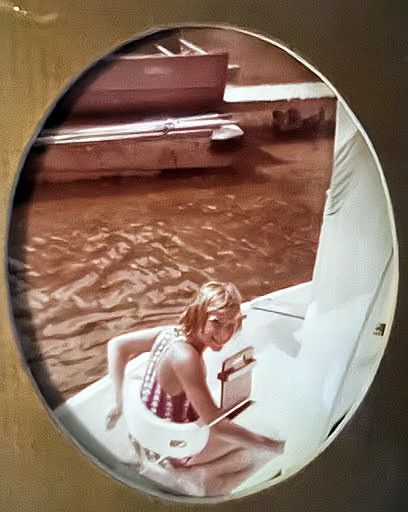
My grandmother always had a flower garden because she loved fresh flowers in the house. She often had a bouquet picked from her flower beds. The flower that she never wanted to see was carnations. Carnations were the only thing she remembered about being at her father’s funeral and it was traumatic for her. Her favorite flowers were daisy’s and black-eyed susans and peonies…or maybe they were just the ones she grew best in her garden? My mother always had rose bushes at the in town house, so I would cut roses and bring them out to my grandmother on the weekends when we came back out to the lake. She was always so pleased to receive them and it made me feel so good when she promptly put them in a vase. In 1974, she invested in a beautiful paddle boat, it was one of the first ones on the lake and it was heavy duty aluminum with a canopy (because she was fair-skinned and tried to keep out of the sun). She used it on occasion to visit with neighbors down the beach or to pick cattails, but she loved watching the grandkids playing on it. She would be so happy to know that we still have this paddle boat, which is used and appreciated by everyone and in fact one of her great-grandchildren (my daughter) wanted to have
a senior picture taken in it. 
 My grandmother never understood my fascination with investigating the family tree, even though she had a wall in her condo in Florida with a painted on family tree and small photos of the several generations hanging on it in! About a month ago as I was sorting through papers I came across a letter she wrote to me in 1981. I loved seeing her handwriting and I could hear her voice say the last line as I read it, “Hope this is what you want dear”. Made me cry. Thank you, Grandma, for supporting me even when you didn’t understand.
 |
We are in the kitchen cooking
for my sister's wedding shower. |
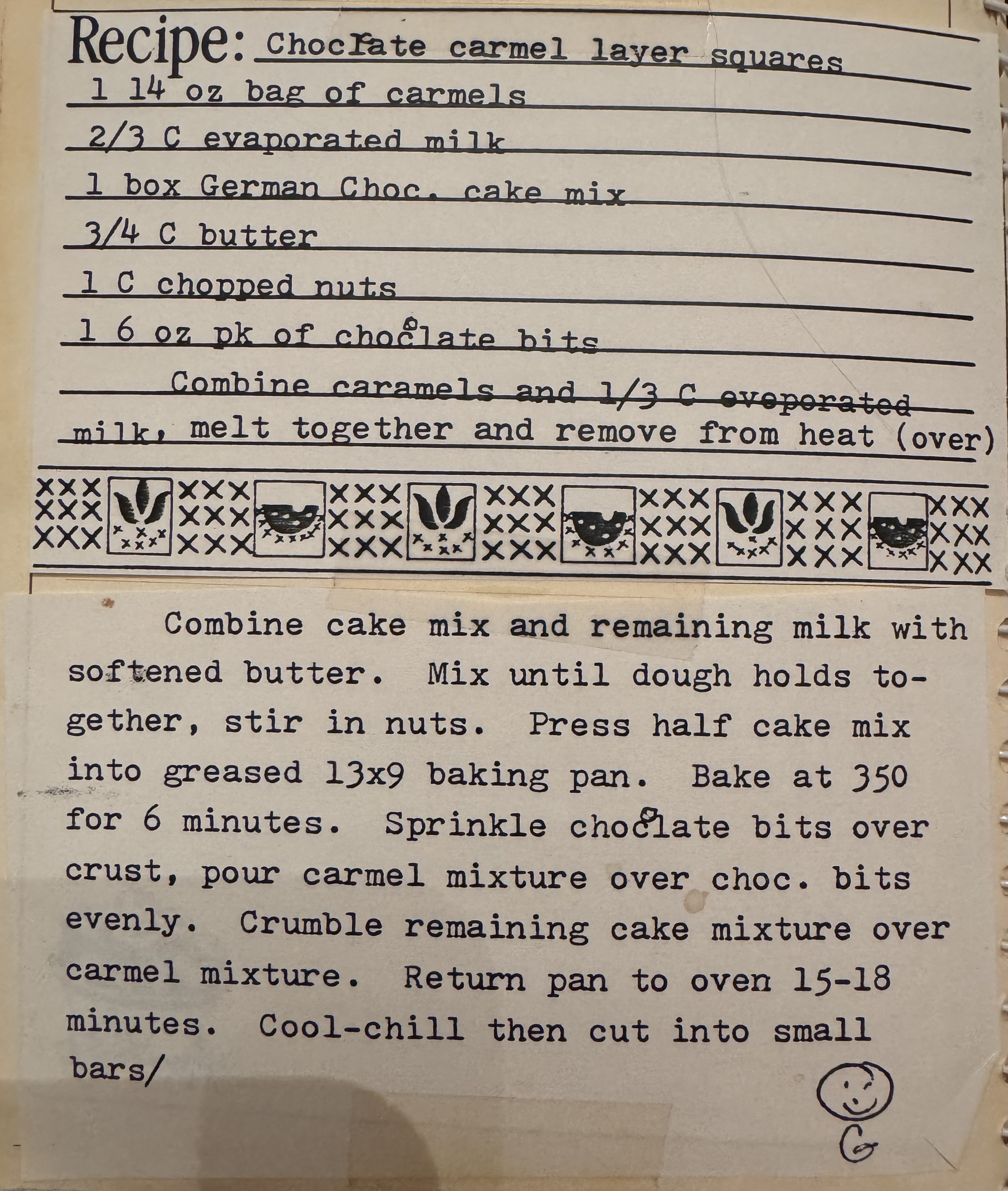
My grandmother was also a good cook. Not the kind to always be cooking in the kitchen or have “specialties” but she was always one with a new recipe! She would go to luncheons to play bridge or go out to dinner parties and come home with a new recipe. Some of these “new recipes” have become some of our family favorites–not so much the main courses, but the desserts. One of these favorites we call “Caramel Brownies”. In fact, I didn’t even realize it until writing this blog today, that both me and one of my daughters made it to share with others this Thanksgiving weekend--without the nuts, but she loved nuts in everything! (The recipe is at the bottom, she didn't like her handwriting and she was quite adept at a typewriter so often typed everything but you can see her trademark smiley face with "G".)
My grandmother was a great listener. I could share anything with her and I appreciated her guidance and loving reassurance or funny little sayings. One that I still use and my kids have picked up on is, when you have decided that although it wasn’t exactly what you were hoping for but are grateful for what you have, she would say, “well, it’s better than a kick in the pants”. She never told me what to do, although on occasion she might say something to put me in my place, “Mary Lynn, don’t let your halo pinch you too tight”! She was always so proud of me and one of my greatest supporters and she then extended that to my husband. When we asked to learn to play bridge, she patiently taught Jim and I and had my grandfather practice with us as a foursome.
She never thought that she would see me graduate from college or get married, but she saw both! She didn’t meet our twin daughters who were born in 1999, but I told her on the phone during our last conversation that I was pregnant, so she knew a baby was coming. Unfortunately, she also passed before I earned my PhD in 2001, but I could feel her presence as I defended my dissertation and knew she would be so proud.
She passed away on October 16, 1998, in Clearwater, Florida and we remember her as a woman who lived life fully, embraced challenges with grace, and enriched the lives of those around her.
I love that Thanksgiving is your Happy 110th Birthday, Grandma–Elizabeth Anna Leach Tubbs. Your life was a gift, and your legacy remains a treasure to us all.