Showing posts with label Michigan. Show all posts

Saturday, February 7, 2026

America250-Revolutionary War Patriots --#2--Col. Abiel Fellows

 Abiel Fellows Jr.  is Jim’s 5th great-grandfather. Abiel Jr. was one of five children born to Abiel Fellows (another veteran) and Elizabeth Rowe and was born on the 1st of Oct 1762. He was born in Canaan, Litchfield County, Connecticut and lived there prior to the Revolutionary War. At aged 15, he enlisted and served as a Private in the Revolutionary War and later during the War of 1812, he became a Colonel.


The following is a biography provided in the History of Kalamazoo County, Michigan (1880) pp. 454-455.


COL. Abiel Fellows“ was born in Canaan, Litchfield Co., Conn., Oct. 1, 1762.  His grandfather emigrated from England, and was among the first settlers in the New England States.  He left a family of five sons and three daughters.  His father kept a public-house in Canaan, and married a Miss Rowe, by whom he had five children.  Abiel, the youngest, received a common-school education.  At the age of fifteen he went out with the Connecticut militia, who flocked to Gates’ and Schuyler’s army.  He was with his uncle, who commanded a division at the battle of Freeman’s Farm, Oct. 7, 1777, and at Saratoga, October 17th, when Burgoyne surrendered.  He then returned home, but shortly after re-enlisted, remaining in the service until peace was proclaimed.  For his services he drew a pension of ninety-six dollars a year.

  At the age of twenty-two he married Katherine Mann.  Their children numbered six,--Andrus, Amanda, Ann, Almira, Abiel, and Asahel.

 In 1785 he went to Luzerene Co., Pa., where he located several thousand acres of land; he sold a portion of it, retaining about one thousand acres, upon which he lived forty-four years, until 1829.

  In 1803 his wife died.  In 1805 he married Dorcas, daughter of Timothy Hopkins, and niece of Rev. Samuel Hopkins, of Great Barrington, Mass.  Their children were Katharine, Thomas J., James M., Simon S., Timothy H., John M., Caroline, Emma, Sarah, Orville H., Milo, Elizabeth, and Lucy.

While in Pennsylvania he was county commissioner for several years, and justice of the peace eighteen years.  He was colonel in the war of 1812; his regiment was with Perry in the battle on Lake Erie, Sept. 10, 1813; afterwards joined Gen. Harrison.

  In 1817 he engaged in mercantile trade, and remained in the business several years.  In 1820 he explored several of the Western States.  He traveled on from Pennsylvania, on horseback, to Quincy, Ill., and located a land-warrant in Fulton County of that State.

  Having comfortably settled his older children in Pennsylvania, he concluded to take the younger ones West and locate farms in a prairie country.  Therefore in 1829, he started for Michigan in early spring, and reached Prairie Ronde in March.  He staked off his claim on Gourd-neck Prairie, returned to the eastern part of the State, and wrote his sons Thomas and James to come immediately to Michigan, for he had found the Eldorado.  They came, arriving some time in May.  In the mean time, Joseph Frakes and father came up from Young’s Prairie, took possession of his claim and held it.  He then located on the southwest side of Prairie Ronde, now section 36, T. 4 S., R. 12 W.  They built a house and commenced fencing and plowing.  The land not being in market, he could not secure it by purchase, and was obliged to remain on it in order to retain it.  In 1831 he purchased four hundred acres in a body, in Prairie Ronde and Schoolcraft townships.

  In 1830 he was appointed postmaster of Prairie Ronde, and also had the contract for carrying the mail from White Pigeon to Prairie Ronde.

  The same winter he built a saw-mill on Rocky River, on section 26, Prairie Ronde, the first saw-mill in Kalamazoo County.  He sold his mill to Wheeler & Crosby in 1832.  He was supervisor and highway commissioner, and with Christopher Blair and Delamore Duncan laid out the first road from Prairie Ronde to Bronson (now Kalamazoo), and assessed the first tax in the county.

  In 1832, the year of the Black Hawk war, when Col. Fellows was seventy years old, he carried for Lyman I. Daniels, who was acting colonel, and was also land-agent for parties in Detroit, important papers and some money to Detroit.  He rode a horse, carrying the papers and money in saddle-bags, and reached Detroit in three days, a distance of one hundred and sixty-five miles, and after transacting his business made the return trip in three days.  Lyman I. Daniels said he was the only man he could find with sufficient courage to undertake such a perilous journey.  He was brought up a strict Presbyterian, was generous, benevolent, ambitious, courageous, and of a strong temperament.

 He died on the 18th of August, 1833, in the seventy-first year of his age.”

Other References

As was mentioned above, he served in two distinct time periods during the Revolutionary War. He was first in battle as part of the Saratoga Campaign in October 1777 at Bemis Heights and Saratoga. It is likely that he wasn’t actually there for the Freeman’s Farm battle which was stated above, if the date is correctly listed.

The document below is related to his second enlistment and is from p. 570 of the Record of Service of CT men in the War of the Revolution. The list begins on page 569 as Capt. Matthew Smith’s Company. This is also documented in the DAR Ancestor record #A038829.

In Fold3.com, I found an 83 page file related to Abiel Fellow Jr’s pension to his wife Dorcas primarily for his Revolutionary War service but also mention of his service in 1812, in which he was a Colonel.

What is not included above since it was written prior to 1905, is that a DAR Chapter was begun in Three Rivers, St. Joseph County, Michigan and named the Abiel Fellows DAR Chapter in honor of the coordinating regent Lucy Fellows Andrews.

The most robust and well documented biography of Abiel Fellows Jr was found in the Wikitree.com community of Abiel Fellow Jr.


Friday, January 30, 2026

The Amazing Power of Newspapers: Part 3

My grandpa, Walter Elliot Tubbs,
and me c. 1983
Last week, I participated in the Genealogical Society of Washtenaw County’s monthly meeting which hosted a speaker from the Library of Michigan. As part of his overview of their services he reminded me that they maintain a newsbank of newspapers, which includes The Ann Arbor News back to 1923. I thought that I would do a search for mentions of my grandfather, Walter Elliot Tubbs, who was born in 1911 in Washtenaw County and lived in Ann Arbor into the 1940s.

His Name in Youth

As it turned out, I spent hours combing through the mentions of my grandfather in a myriad of activities in his teenage and early 20’s. What was interesting is that in most of these newspaper mentions he was named as Elliot Tubbs. When I was growing up, most people called him Tubby, a nickname he picked up while in the Army, except for my second cousins who always called him Uncle Elliot. I thought it was odd because I knew his first name was Walter. Then it dawned on me, his father was Charles Walter Tubbs, but he went by C. Walter or Walter. Since it might be confusing to have two Walter’s in the house, my grandfather must have been called Elliot as a child and my Aunt Helen, his older sister, would have surely had her children call my grandfather by his childhood name. The newspaper articles later shifted to using Walter Elliot in the 1940s, but the name must have stuck for my cousins!


Ann Arbor High School Yearbook, c. 1931

The Ann Arbor Times News
March 20, 1926
The Ann Arbor News
October 13, 1925


The Ann Arbor Times News
November 18, 1925

Activities of his Youth

I was a competitive swimmer in my youth and my grandfather was always so proud of me and on rare occasions he would mention he was also a swimmer and would share how much strokes, starts, and turns had changed and even the length of the pool (he swam in a 20 yd pool) since he was a kid. I found numerous articles during his teenage years participating in the Ann Arbor YMCA and Ann Arbor High School swim team. For example, on October 13th, he placed 5th in the “Athletics” division at the YMCA Carnival and 4th in the “Swimming” and 3rd in the “All-round” category. Most times he was a swimmer but I did find one time that he made it to the semi-finals for “Fancsy Diving”! And was on the Ann Arbor YMCA Team (Junior division) planning to defend their state title and he was a “low board diver”. 

Ann Arbor High School Yearbook
c. 1930


The YMCA also sponsored treasure hunts and at the first treasure hunt in the summer of 1925, Elliot Tubbs won the event. And he even played in ping pong tournaments!

Ann Arbor High School
c. 1929


My grandfather also prided himself on his singing voice, although I don’t ever remember hearing his tenor singing voice, he was a member of the Glee Club at Jones Junior High and Ann Arbor High School.

The Ann Arbor Times News
Aug 15, 1924

He was also a Boy Scout in Ann Arbor’s Troop 1 and went to Camp Medawewin on Patterson Lake in Pinckney, Michigan and learned about water safety, lifesaving, and techniques for swimming and diving.


Surprising Find

The most surprising find was in 1933, when Elliot Tubbs was identified as an Old Age Pension Bureau census enumerator. This took me down a giant rabbit hole where I learned an interesting lesson in Michigan History!!

The Ann Arbor Daily News
November 6, 1933

Most people know that Social Security as a federal program began in August 1935. What I didn’t know until reading this article was that Michigan began a program that could be considered a precursor to social security! Michigan was struggling with one of the highest unemployment rates (36% vs. 24% nationally) and had many poor houses filled with elderly persons. It became a very controversial law (I found a New York Times article from December 1933), but in 1933, Michigan was one of 10 states who began a program to support indigent persons over the age of 70. They levied a tax of $2 per person (over the age of 21) per year to fund the program. In order to know who to levy this tax against, census takers were hired to scour townships. My grandfather was apparently named the census taker for Scio Township in Washtenaw County, a township he would have been familiar with because his parents were both born there and he was too!


I have reached out to the Michigan Archives and the Genealogical Society of Washtenaw County, but haven’t tracked down the census papers he took…yet!


I am again reminded of the power of newspapers and how they can bring a person's life alive! There was so much more to my grandfather than his military career and it's nice to learn a little more about him as a young man.


************
Extra Reading about the Old Age Pension in Michigan


Sunday, August 24, 2025

Oh, what a find!

I am volunteering again this summer at the Tecumseh Historical Society & Museum, helping to organize and catalogue their vertical files. Last week, I came across a set of photos donated in 2006 by a woman whose aunt was a subject of some of the photos with the family she married into. This family was the Rosacrans family from Tecumseh whose family owned the Rosacrans & Sons dry goods store for 95 years, closing in the 1960’s.

A few of the photos were particularly interesting because she claimed that they were taken in 1922-24 at their cottage on Sand Lake! This is the lake that I have spent every summer of my life. I have spent hundreds of hours researching many of the people and cottages around the lake with my father and was curious where this cottage was.


After a week of various investigations…searching deeds in the court house and tax rolls at the Lenawee County Historical Museum, looking for people/photos at the Tecumseh Library, watching the 1980’s Oral History of Ned Rosacrans (a young boy in the photos), and posting the photos to two different historical facebook pages, I had nothing!


I learned a lot about the Fred Rosacrans family, their kids, and grandchildren. I even learned that they lived (and Ned grew up) in a house at 207 N. Union St, which was next door to my husband’s family! (A house that my husband’s great-great-great-grandmother, Harriet Spofford Webster built in 1850 and 4 generations of his family lived in for almost 100 years! In the 1920’s Jim’s great-great grandmother Eliza Virginia Webster would have still lived in the house, although her husband Myron Conklin died in 1922 after over 50 years of marriage.)

                                                                                            Fred Rosacrans House, 207 N. Union St.

Webster-Conklin House, 211 N. Union St. c. 1980s
Webster-Conklin House, 211 N. Union St. c. 2023

There was one last place I learned about to look…it turns out that there were home movies that Fred Rosacrans made. So yesterday at the Tecumseh District Library, I watched the Fred Rosacrans home movies that he took in 1928 and 1929. It was an amazing silent film filled with every day and special occasions. There were images of boys ice skating on a local pond, playing baseball, men bailing hay, Memorial Day parades, GAR gatherings…and then there it was!


Unexpected and so surprising... nothing about Sand Lake...instead there was a home movie of Eliza Virginia “Jenny” Webster in 1928 (Jim’s great-great-grandmother)! I have seen plenty of photos of her and in fact last year I found a few more (check out blog
Sometimes you really luck out!) but I never imagined I would ever see a video of her! This is NOT AI or just animating a photo, this was really truly Jenny sitting on her front steps welcoming (I think her granddaughter) Georgianna Conklin. I wish I could hear her voice, but this is an absolutely amazing find, so I will take it!


This is a reminder to me to keep my eyes open, you never know when you will come across something completely unexpected and totally wonderful!


Wednesday, May 21, 2025

Kool History

Jack & Jamie, c. 2012

Just about a year ago, I wrote the blog post History of Today for Tomorrow about Tove Moon and our Tulip Tree, hoping to capture the history of today. This is a similar post capturing the history of today and a fun little boat.

Getting underway


A couple weeks ago my husband was at an auction and he saw some David Armstrong photos. I wasn’t familiar with David Armstrong’s art, so I looked up some of his work and was secretly very glad that he let others bid on it. This prompted me to look at the recent work of an artist whose work I do have on our walls at our cottage on Sand Lake in Michigan. The artist is Curt Baldwin, who works in oil producing paintings of subjects and images from his childhood summers “on the southern shore of a small midwestern lake”. I know Curt, he is the youngest son of family friends we have on the lake and I hung out with his older brother and cousins. Many of his works are named for people or places on the lake and in fact, there is one with my family’s name and it proudly hangs on a prominent wall in our cottage.


Source: Curt Baldwin Artist Website

In checking out his latest works in 2025, I came across the following: “The Kool”. OMG!! That’s OUR Sea Snark sailboat! I actually don’t know if Curt modeled this after our family’s sailboat but I don’t remember there being another Kool sailboat on the lake. I will have to ask him this summer!

Source: Online Exhibits-Yale
Why “Kool” and not “Cool”? 


Me & Kim, c. 1978

Well, it’s because in the 1970’s, Kool cigarettes had a marketing campaign, slogan, and “giveaway”. The slogan, “never a rough puff” and their opening lines of the advertisement, “Not with the taste of extra coolness in Kools. And now, for more smooth sailing, we’re offering you the world’s most popular sailboat, the Sea Snark.” For $88 and the carton’s end flap, you could have your own Sea Snark with Kool sail. 


My grandfather smoked Kool cigarettes, so this was an easy thing for him to get. My grandfather loved spoiling his only child (a daughter–my mom) and grandchildren so he bought the sailboat for the family–I don’t ever remember him sailing in it. It appears that the first year the promotion was offered was 1971 and I read that they produced about 18,000 of these Kool Sea Snarks. According to Wikipedia, it was repeated in 1972 and 1975. I don’t know which vintage (or if there is a way to tell) ours is (and I say “is” because we still have it and occasionally bring it out). Generations have learned to sail using this little Kool boat!  It is a styrofoam hull sailboat with a total length of 11 feet and beam of 3 feet. It is an EXCELLENT boat to learn to sail, so safe and easy for one or two.


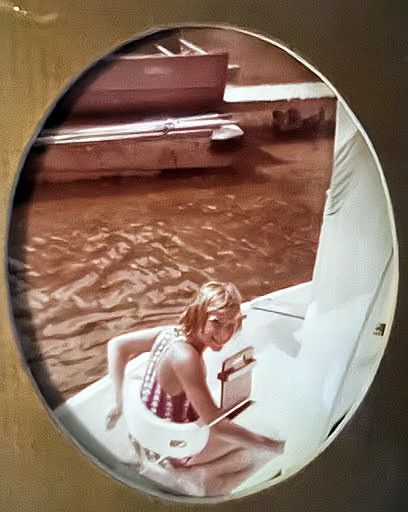
I couldn’t find a photo of my dad by himself in it, but in my mind’s eye I can see the day my dad entered the Sand Lake 4th of July sailboat race in this boat. I did, however, find photos of me sailing in it. By the looks of my glasses the first picture was taken in 1978 and then the second a few years later.


Jack & Don, c. 1999

We also have photos of my dad teaching my nephew (c. 1999) and then my daughter and nephew venturing out by themselves (c. 2012, above). 


I so appreciate Curt creating this work and I can’t wait to buy a print of it to mount along side these other photos to record the history of today for tomorrow.


Thursday, January 9, 2025

The Beauty of Community

Pardoning Board of the State of Michigan
under Gov. Geo. Bliss, c. 1903

 I love being a family historian because I love mysteries and uncovering new truths. I also enjoy being a part of a community helping one another in their own searches. In genealogy, we are taught to document and cite and compelled to do so (see Elizabeth Shown Mills book Evidence Explained or the Genealogy Standards).

It is good practice for one's own research–it’s a heck of a lot easier than having to go back years later and try to recreate how you know something is true or where an original photo might live–and you can’t help out the community if you don’t do it. When working with others, I keep excellent track but with my own family I do a so-so job and every January I find myself listing “Document and cite everything” among my New Year’s Resolutions so do better. Sometimes, just sometimes though, I do do it right.

Lansing State Journal
10 Jul 1903

In 2012, I shared the group photo of my husband’s great-great-grandfather Russel Ralph Pealer (1842-1919) with other board members (he’s 2nd from the right) on my Ancestry.com family tree and included (unbelievably!) in the notes section what was written on the back, “R. Holzhey, Photographer, Marquette, MI. Taken when on pardoning board under Geo.(sic) Bliss”. Russel was born in Columbia County, Pennsylvania, actually not too far from where we live now. Russel was a member of the 16th Pennsylvania Cavalry, known as “Gregg’s Cavalry” during the Civil War. After the war, he continued his study of the law and was admitted to the bar in Pennsylvania in 1867 and later that year to the bar in Michigan. He moved with his wife to Three Rivers, Michigan where he practiced law, became a Circuit Judge, and eventually served on the Pardoning Board for the State of Michigan. This photo was taken between 1901-1903, while he was serving on the board. 


R.R. Pealer c. 1865
Fast forward 8 years to August of 2020, I was contacted by two historians from the Netherlands and asked if I owned the original photograph. (Thanks to Jim’s Aunt AnnaMarie Breyfogle Austin, we inherited this among MANY wonderful photos of RR Pealer most dutifully identified by Jim’s grandmother Bertha DeBoer Breyfogle) The Dutch historians had found the photo while researching in Ancestry.com and they were interested not in any of the people in the photo but rather the photographer! They were writing a book about the photographer, Reimund Holzhey, who had quite an interesting life after immigrating to the United States from the Netherlands. Reimund, for unknown reasons, resorted to robbing stagecoach and train passengers in northern Michigan and Wisconsin during the late 1880s. During one such event in the summer of 1889, he shot a man (Adolph G. Fleischbein) who died the next day. A massive manhunt was created and he was eventually caught in Republic, Michigan in the fall of 1889. He was sentenced to life in prison and sent to Marquette prison in the Upper Peninsula. 


He was a difficult prisoner until 1893 when he underwent surgeries related to a childhood brain injury and was completely transformed as a result. He became a model prisoner in Marquette and developed a passion for reading and photography!  The rest is history, as they say, and although I can’t read the book they produced and I own a copy (it’s written in Dutch), I can appreciate that I have helped to contribute to the story and the book. The authors have told me that the book was nominated for the most important history prize in the Netherlands and they are pleased with its reception. They are currently looking for a publisher in the US, so someday it might be printed in a version that I can read! (Most of the information for this blog about Reiumund Holzhey was found in an article  called “The Last Stagecoach Robber in Michigan” on Michiganology.com that was adapted from one that appeared in the Summer/Fall 2018 issue of Trace, the Archives of Michigan magazine.**)


Who would have ever dreamt that a photo of my husband’s great-great-grandfather, Russel Ralph Pealer (1842-1918) would find its way into a Dutch book in 2021?! It’s a beautiful story of the wonders of the internet, a culture of sharing, and the beauty of community. 


**In case you were interested, Reimund’s sentence was commuted by Governor Fred Warner on the advice of the warden, James Russell, in 1910. He was discharged in 1913 and lived and worked as a photographer wherever he found tourists, like Yellowstone and Captiva Island until 1952!


Thursday, November 28, 2024

Thankfully Celebrating My Grandmother's 110th Birthday

Today is Thanksgiving, November 28, 2024 and it would have also been the 110th birthday of my grandmother, Elizabeth Anna Leach Tubbs. A woman I am so very thankful was a part of the first 30 years of my life! So today’s blog is dedicated to her.


Early Life

Clay, Florence, and Elizabeth

Elizabeth Anna Leach was born on November 28, 1914, in Hancock, Michigan, the third and youngest child of Edward James Leach and Florence Mary Stoddard. Her mother always called her Elizabeth, but I heard most people call her Betty or “Tibby”, but the second nickname comes after meeting my grandfather.  Betty faced the early loss of her father at just five years old. Despite this hardship, she grew up with a strong spirit, spending her formative years in Michigan, particularly in Reed City with her mother, brother, and grandparents while her mother secured her teaching certificate and then later in Ypsilanti when her mother found an elementary school teaching position. Her early life set the foundation for her unyielding perseverance and adaptability.

Betty’s mother never remarried and I think was an incredible model of female independence and fortitude for her. Although my grandmother was married for nearly 60 years when my grandfather died, she was an independent woman and raised her daughter (my mother), and taught my sister and I to be independent, developing our own careers so that we could live without a spouse. “Mary Lynn”, she would say, “you never want to be dependent on a man!”

1937 Wedding
In 1935, Betty and Walter Elliot Tubbs (called “Tubby” by friends) eloped and two years later in 1937 they had a beautiful wedding that made her mother happy. (I wrote about that in The
Amazing Power of Newspaper: Part 3). I don’t know if this is true for my grandparents, but my Uncle Clay (Betty’s brother) and Aunt Vivian also eloped in the 1930’s and they always said it was because during the deep depression married women were not allowed to hold a teaching position, so they eloped and lived apart for a while.

It’s only speculation, but I believe that my grandparents met at Michigan Normal School (now Eastern Michigan University). Betty’s older brother, Clay, was also at Michigan Normal School and I believe knew Tubby first. The story of how Betty and Tubby met is forever lost, along with exactly why they chose to elope, and who Betty was originally engaged to before meeting my grandfather! We only know that she broke off her engagement!

Early Married Life

Tubby’s father and older brother (11 years older!) served in World War 1 (actually in the same unit!) and his brother made a career of the military, so it was not surprising that Tubby would too. He started in the National Guard and did two terms before joining the Army. By 1941 he was promoted to Lieutenant and stationed in Louisiana, which is where my mother Mary Anne Tubbs was born in December 1941. She is the only child of Betty and Tubby and although more would have been welcomed, it was not to be. 

Source: Collection of the Henry Ford

During the war years, Betty and little Mary Anne were back in Michigan, where Betty could work and live close to her mother and in-laws. I have been told (but I haven’t yet been able to confirm it) that Betty worked at the Ford Motor Company Willow Run Bomber Plant in Ypsilanti during these years. Some sources say that 12,000 women were hired and they were paid the same rate as men ($0.85/hr) in one of two nine hour shifts a day. This is the plant that prompted the Rosie the Riveter campaign. At their peak production they were making a B-24 every HOUR! (sources: Willow Run | Detroit Historical Society and How Ford's Willow Run Assembly Plant Helped Win World War II | 2019-01-03

If this was true, I know it would have been at least her 2nd foray into factory line work. She told me the story that when she was younger (I’m assuming teenage summer work), that she lived with her grandparents in Reed City and worked at a cherry canning plant. She described working on a line with a chute as cherries were hurtling past. The workers were supposed to pluck out the rotten or wormy cherries and place them along the edge. As a result of working there she NEVER EVER bought a can of cherry pie filling or any canned cherries because she KNEW how many rotten cherries went past her. For anyone who ever watched the I Love Lucy show, remember the iconic episode of Lucy and Ethel in the chocolate factory? Yeah, that’s what I imagined as my grandmother was telling me the story…except I’m sure she was not popping the cherries into her mouth!

Credits: Vachon, J., photographer. (1940) Untitled photo, possibly related to: Migrant girls working in cherry canning plant, Berrien County, Mich. United States Michigan Berrien County, 1940. [July] [Photograph] Retrieved from the Library of Congress, https://www.loc.gov/item/2017720609/.

Beside working and taking care of young Mary Anne and doting on her mother who was also working, she was the consummate hostess in various societies. Both she and her mother were members of the Ypsilanti DAR chapter and I have numerous newspaper articles identifying Betty as the hostess or meeting presider during the years immediately before the war and then again right after.

Middle Married Years

After WW2 ended, life changed dramatically for this young family. My grandfather was stationed first in Japan from 1946-1949, so the whole family moved and lived there with him. My grandfather was making the military a career and moving up the ranks. My grandmother became an Army Officer Wife and learned to live this part. My grandparents became known as Tubby and Tibby, my grandfather earning his name because he was always a little portly and my grandmother maintained a thinner figure. My mother tells me that this period in their life was pretty “cushy” with a maid and cook and my grandmother playing bridge and entertaining other officer wives. My parents entertained a lot as I was growing up and they were spectacular hosts! As I reflect back on it, I’m sure it was my grandmother’s influence and model for my mom. 

The two Tubbs brothers.

My grandmother, too, was an excellent hostess and having “everything just right” was important. For example, the ketchup (she called it “catsup”) bottle could never be put on the table, it must be served in a bowl with a spoon and there were always many condiments (for any meal) like pickles of various varieties and pickled beets. She had hors d’oeuvres every day before dinner which usually accompanied her 4pm Manhattan cocktail. I’m sure much of this was learned by her own mother who grew up in the Victorian Era whose family members’ names frequently graced the social columns of the newspaper, except that last bit…the Manhattan cocktail. Her mother, my great-grandmother, was a teetotaler and never had a drink in her life…except the one time when she and my grandmother were at a shower of some sort and she tried the punch and remarked to my grandmother how wonderful the punch was! My grandmother told me that she didn’t have the heart to tell her that it was spiked with alcohol. But I digress.

Betty and Tubby returned stateside for a few years before going overseas to West Germany from 1952-1955. This was less ”cushy” but still did allow for some European travel and weekend trips. Once they returned stateside in 1955, the family stayed, although my grandfather was stationed in Iceland and while abroad missed many of my mother’s high school milestones, including her graduation. My grandmother, much like her own mother, was the glue that kept things together and took on a job along with taking care of her daughter and doted on her now retired mother. She was now an accountant at Eastern Michigan University.

It is because of my grandmother that we spend our summers at my happy place! Because of her work, she knew the Rynearson family who owned a cottage on Sand Lake. In the early 1960s, the Rynearson's wanted to sell and my grandparents bought the first cottage our family owned! I am so very thankful to my grandmother for encouraging them to seize the opportunity and the foresight to keep it in the family.

Later Married Life

My grandmother was devoted to her mother, which kept them in the Ypsilanti area. When my grandfather returned from Iceland, which ended his 20-years of service, he retired from the Army and became a high school industrial shop teacher in River Rouge. Both of my grandparents retired and became snowbirds (spending the summers at Sand Lake and the winters in Clearwater, FL) shortly after my great-grandmother passed away in 1974.

They lived in On Top of the World, a 55 and older retirement community, on a golf course. They played golf, played bridge, rode large wheeled tricycles, and entertained and went to parties in their retirement. I knew her mostly in her retirement years, because I was still small when they retired. And I spent most of my time with them at Sand Lake. 

In the summer at Sand Lake, we lived two houses away and every day I would run over to their cottage to see them. Like most older people, my grandma was a creature of habit. She didn’t usually eat much breakfast but she had her coffee, toast, and a cigarette. Yes, she was a smoker. I think it was the Officer Wife thing in the 1940s and 1950s. She wasn’t a heavy smoker but smoked enough that she was very concerned about the smell, so she always had rolls of Certs everywhere and she often would be sucking on one. She also wore perfume and had air fresheners in the cars and house to help. She was an early riser but also always took a nap in the afternoon. After lunch, she would retire to her bedroom with a book (she was an avid reader too) and take a nap. After her nap was time to prepare the hors d'oeuvres and dinner so that by 4pm she could have her Manhattan. They often went into Ann Arbor to meet up with friends or entertain their friends at the lake. And she never went out without lipstick and her clip on earrings.

Cherished Memories

This was my 5th birthday party at the lake.
Notice the flower arrangement!


My grandmother always had a flower garden because she loved fresh flowers in the house. She often had a bouquet picked from her flower beds. The flower that she never wanted to see was carnations. Carnations were the only thing she remembered about being at her father’s funeral and it was traumatic for her. Her favorite flowers were daisy’s and black-eyed susans and peonies…or maybe they were just the ones she grew best in her garden? My mother always had rose bushes at the in town house, so I would cut roses and bring them out to my grandmother on the weekends when we came back out to the lake. She was always so pleased to receive them and it made me feel so good when she promptly put them in a vase. In 1974, she invested in a beautiful paddle boat, it was one of the first ones on the lake and it was heavy duty aluminum with a canopy (because she was fair-skinned and tried to keep out of the sun). She used it on occasion to visit with neighbors down the beach or to pick cattails, but she loved watching the grandkids playing on it. She would be so happy to know that we still have this paddle boat, which is used and appreciated by everyone and in fact one of her great-grandchildren (my daughter) wanted to have
a senior picture taken in it.

My grandmother never understood my fascination with investigating the family tree, even though she had a wall in her condo in Florida with a painted on family tree and small photos of the several generations hanging on it in! About a month ago as I was sorting through papers I came across a letter she wrote to me in 1981. I loved seeing her handwriting and I could hear her voice say the last line as I read it, “Hope this is what you want dear”. Made me cry. Thank you, Grandma, for supporting me even when you didn’t understand.

We are in the kitchen cooking
for my sister's wedding shower.

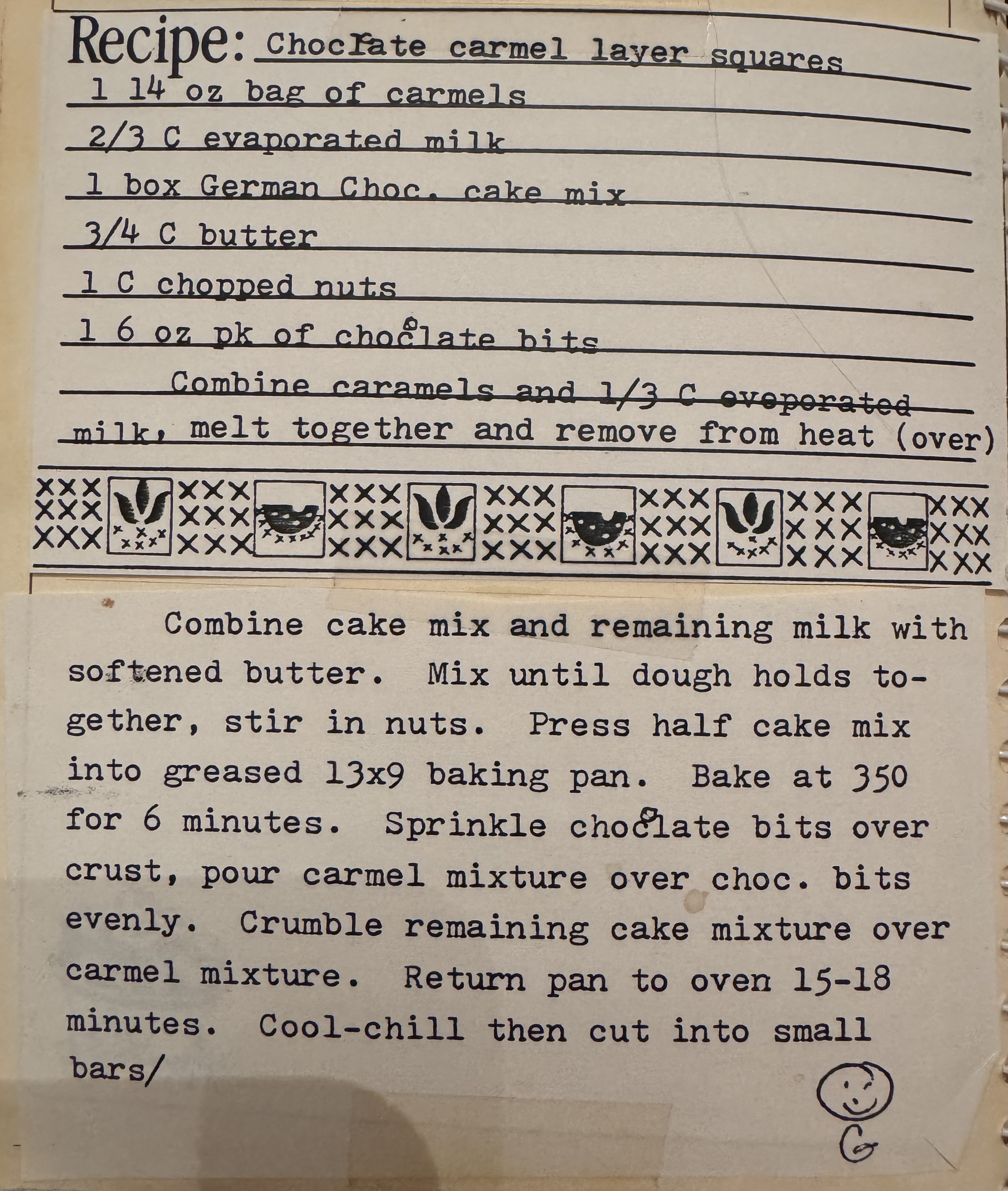
My grandmother was also a good cook. Not the kind to always be cooking in the kitchen or have “specialties” but she was always one with a new recipe! She would go to luncheons to play bridge or go out to dinner parties and come home with a new recipe. Some of these “new recipes” have become some of our family favorites–not so much the main courses, but the desserts. One of these favorites we call “Caramel Brownies”. In fact, I didn’t even realize it until writing this blog today, that both me and one of my daughters made it to share with others this Thanksgiving weekend--without the nuts, but she loved nuts in everything! (The recipe is at the bottom, she didn't like her handwriting and she was quite adept at a typewriter so often typed everything but you can see her trademark smiley face with "G".)

My grandmother was a great listener. I could share anything with her and I appreciated her guidance and loving reassurance or funny little sayings. One that I still use and my kids have picked up on is, when you have decided that although it wasn’t exactly what you were hoping for but are grateful for what you have, she would say, “well, it’s better than a kick in the pants”. She never told me what to do, although on occasion she might say something to put me in my place, “Mary Lynn, don’t let your halo pinch you too tight”! She was always so proud of me and one of my greatest supporters and she then extended that to my husband. When we asked to learn to play bridge, she patiently taught Jim and I and had my grandfather practice with us as a foursome.

She never thought that she would see me graduate from college or get married, but she saw both! She didn’t meet our twin daughters who were born in 1999, but I told her on the phone during our last conversation that I was pregnant, so she knew a baby was coming. Unfortunately, she also passed before I earned my PhD in 2001, but I could feel her presence as I defended my dissertation and knew she would be so proud.

She passed away on October 16, 1998, in Clearwater, Florida and we remember her as a woman who lived life fully, embraced challenges with grace, and enriched the lives of those around her. 

I love that Thanksgiving is your Happy 110th Birthday, Grandma–Elizabeth Anna Leach Tubbs. Your life was a gift, and your legacy remains a treasure to us all.


America250-Revolutionary War Patriots --#6--Lt. Caleb Hopkins

Jim’s 5th great-grandfather, Lt. Caleb E. Hopkins (1749-1824) DAR (#A047932) served as a Lieutenant Revolutionary War Patriot.  He was the s...