Monday, July 17, 2023

Making it back to the Mayflower?!

 I feel so lucky as a family historian to have a variety of ancestor experiences to uncover. I have German immigrants who came in the 1850’s to Germania, PA, Hungarian immigrants in the 1870’s who I have connected with the Christoff’s of western PA (Brick wall to beautiful mosaic),  I have a “mystery orphan baby” left “on the wheel” in Italy in the 1870’s, I have Scottish ancestors who settled (via Canada)  to the Upper Peninsula of Michigan in the 1860’s,  I have Civil War veterans (Celebrating Civil War Veterans), Revolutionary War veterans, and now possibly Mayflower passengers. 

One of my goals this year was to prove a line back to the Mayflower and join the Mayflower Society. One might ask “why?” and you can read about the benefits here, but my main reasons are the verification and documentation of my ancestors and the continuous opportunity to learn as a family historian. And in this past week, it’s getting closer to becoming a reality!


Early Research


For over 20 years, I have been gathering information and documentation on my family history and have known about the Stoddards and Tubbs families who came to the New England colonies in the 1630s. These are close but no cigar for the Mayflower!


 I’d say in the past 5 years I have seen other people’s trees on Ancestry.com that had similar ancestors to me that suggested I had at least one line to the Mayflower through my mother’s paternal grandmother (Cora Viola Orcutt–the one’s whose Irises I enjoy.) Last fall, after being accepted into DAR, I went to the DAR Library in DC (Note: you do NOT have to be a member to make use of the library!) to start really investigating for the Mayflower. 


Beginning Serious Research


Step 1: I had heard about the Silver Books but it was at the DAR Library that I first was able to explore them. The Silver Books refer to the documented, verified, and accepted collection of volumes of the first five generations (and in some cases farther) of the passengers of the Mayflower. It was truly a Herculean feat to put together these books and we can thank the Mayflower Society that continues to update them.


Step 0: Before consulting these, though, you need to know which pilgrim you are connected to. The Silver Books are organized by pilgrim into separate volumes.  It is wise to have the proposed lineage mapped out for yourself, so you can see if the first 5 generations match yours. 


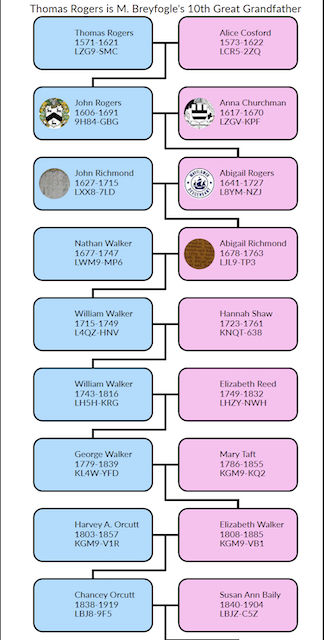
I didn’t learn this until later in my journey, but there is a helpful website, called Relative Finder,  which provides possible lineages based on your Family Search tree. This obviously means that you need an account and have entered in enough of your family tree to connect with the world tree that is there. You can see that this tool searches for more than just Mayflower Relatives, but I am showing just the Mayflower Direct Connections for my family. Hopefully you have more than one line as possible, but choose one and try to prove it. I chose to work on two lines, one from Thomas Rogers and one from John Cooke. 


Just like any resource, there are bound to be errors, so you need to do your own research to confirm, but this is the place to start. There is another tool through Family Search that ties into the Mayflower Society descendancy records, but if your family is like mine and have to prove a lot of generations, it is not likely to be too helpful.


Step 2: Try to find another published family history that might start to give you ideas of what has been documented and what resources to go to for documentation. For me, the Silver Books proved through generation 6, to William Walker and the place to start was to show that George was the son of William Walker. When I went to the Allen County Public Library (ACPL) see my post, I found a book on the Walkers:  Memorial of the Walkers of the Old Plymouth Colony Embracing Genealogical and biographical sketches of James, of Taunton,... and of their descendants from 1620 to 1860 by J.B.R. Walker, AM (Member of the Old Colony Historical Society” Printed by Northhampton: Metcalf & Company, Printers. 1861). This book provided me the next several generations through to my mother’s great-grandfather, Chauncey Orcutt. Since I knew the line from there, I was OVER the MOON to find my great-great-grandfather mentioned being in Ann Arbor, Michigan, in the book printed in 1861!


Step 3: Once you are confident that you have a line, you can submit a Mayflower Lineage Match (MLM). There is a fee and it may take 2-3 months to hear back, but it is an important step. Once you have submitted, the Mayflower Society will investigate other previously approved lineages and see where your line intersects previously approved. For me, I am the 13th generation and I was informed that they have proven through generation 7! Only 6 generations of birth’s, deaths, and marriages for me that needed to be proved!


Step 4: Once your MLM (from Step 3) has returned, the Mayflower Society also notifies your state’s historian for the state’s Mayflower Society. In my case, I will be joining through the PA Mayflower Society and I was connected with my awesome Co-Historian Sharyn Davis. Sharyn was an absolutely amazing resource and helped me each stage of the way from here. I learned soooo much from Sharyn, and she did so much work for me!! 


Your Historian will evaluate your line and will have you send in the documentation you have already collected and then set you on a path to collect the rest. I started with my own generation and worked backward toward the 7th generation.


This last step began June 16th and the next several weeks were a whirlwind of document gathering and submitting. Each day, I would send Sharyn an email with information or documentation and she would respond back usually providing more guidance and instruction. County Clerks offices, cemeteries, county historians, town clerks, and town historians were contacted both in New York and Michigan. Censuses, property records, newspapers, and lots of websites were scoured! It was a fun and fulfilling process, but is not for the faint of heart! I can’t even count the number of hours spent trying to gather the information!


We *think* we have provided enough documentation to “prove” my line, but it needs to go through final evaluation in Plymouth. I should know sometime this fall.


Meanwhile, I’m off to work on Jim’s Mayflower line….


Friday, July 7, 2023

Names really can tell us a lot about a person!

Me with Diahan Southard, March 2023

I’ve written before about names earlier this year because my great-grandfather was a baby left “on the wheel” in Villa San Giovanni in the 1870s and just randomly given a name. (See Names and Naturalization, February 7, 2023) This week’s blog is about a new-to-me resource that I think is pretty cool and even non-family historians might think so too!


The Sawtooth Slayer


In March, as part of the Rootstech Conference, YourDNA Guide Diahan Southard hosted the first-ever DNA Dining Detectives Murder Mystery Experience, and I was one of the lucky ones to go! It was an awesome and interesting night of teaming up using DNA genetic genealogy techniques to solve a mystery. The mystery was based on the book by Nathan Dylan Goodwin called The Sawtooth Slayer. As part of the evening, we received a copy of Diahan Southard’s YourDNA Guide book (definitely worth it for those tough DNA brick walls) and also Nathan’s book.


I just finished the book and although I knew “who did it”, it was still a fun read. What I didn’t expect was to learn about a new very fun resource in the process!


Finding a Name


Have you ever wondered what the most common surname is in the world? This is easy enough…just ask Google, Siri, Alexa, or your favorite device….Wang! Have you ever wondered about how common your own surname is? Or maybe where all of the people in the world live with your surname? In The Sawtooth Slayer this idea was used to investigate the possible historical origins of a particular surname. And Nathan provided a website to investigate this and I tried it out!


https://forebears.io/


This past week I have been doing a lot of research on my Mayflower line and was curious about the Walker line. Here’s some of the fun things you can learn about a surname (or a forename), in this case Walker:

  1. It is the 543rd most common surname

  2. There are approximately 997, 243 people in the world with that name

  3. Location for Walkers

    What the distribution of those names look like (see map)

  4. Origin stories of the name…most agree that Walker comes from the occupation a walker or fuller or cloth maker

  5. The average height of people with that name–64 inches for a Walker woman

  6. Sometimes the average income with people with that name

  7. And other random facts.


Location for Orcutts

The other line I worked on this week was Orcutt. What do you think..more common or less? Yeah, that is probably pretty easy. It is the 73, 237th most common surname and about 6,724 people have Orcutt as their last name, with a different distribution. It appears to be named for “a dweller inside a hillside, or riverbank, or cottage”.


What’s my last name (which is my husband’s name) Breyfogle look like?


It is the 452,272nd most common name, with approximately 750 people holding that name, and guess where they are?

Breyfogle's


Pretty funny, eh? Of the 750 people with the name Breyfogle, 728 live in the US.


I guess it shouldn’t be surprising that people often falter over saying my name, it’s not like you might run across a whole lot of us.


Friday, June 23, 2023

History Clarifies the Context!

Being married to a historian is very helpful! And knowing history can help us slow us down and keep us from jumping to conclusions. Let me tell me what happened this week. 


I was nervous and appalled when I thought I read the occupation listed in the original death certificate of nephew (Volney Chapin) to my great-great-great grandmother, Julia Ann Chapin (1806-1888) as…a  “slave dealer”. In both my husband and my family, I have not come across any ancestors who enslaved people or participated in the slave trade, but I’m not naive enough to know that it couldn’t be possible. 

But, I’m getting ahead of myself.


Investigating Land Transactions


Over the past several weeks I have been scattershotting my genealogical research, meaning that I have been trying to collect as much information about all lines of my family settled in Washtenaw County. As a result, I went through the Washtenaw County Deeds on-line (thank you Washtenaw county for having them digitized and available!).


 [A side note—Please learn from my mistake, when you find the actual record and you see something that is barely legible, it’s not because of a bad scan or poor quality of image, it’s because there is a pay wall and before you can truly read it and download, you need to pay $1.20 per page. But that $1.20/page allows you to download, print, and forever keep it!]


I have about 50 pages of downloaded deeds across three surnames (Bailey, Orcutt, and Tubbs) and across nearly 100 years (1827-1923). Each deed is 1 or 2 pages, so that’s a lot of transactions. Most of the transactions are from one family member to another as farm land is shifted from one generation to another. But these also include original purchases in the area–some from the US Government through the Bureau of Land Management.


I haven’t fully digested all of the pages or even figured out where the land was located, but I have taken note of the names. One of the names was Volney Chapin and because it seemed odd to me, I had never heard the name Volney, it stuck with me.


Bentley Historical Library–Geddes and Randall Collection


Yesterday, I was back to the Bentley, searching through the correspondence in the Geddes and Randall Collection (Call Number02155 Aa 2). This is an amazing collection and I appreciate Sarah Geddes Randall very much and whoever donated her collection to the library should be given kudos!


Last week when I was there, I focused on Sarah’s photo albums. Her lovely husband, William T. Randall (brother to my great-great-grandmother Frances Eliza Randall) gifted her beautiful leather bound photo albums (one in 1863 and 1871) where she stored photos of her extended family! They are filled with amazing photos, but unfortunately most are not identified. It might take my lifetime to do that. 


Fortunately, though, a page of photos included one that I recognized–Samuel Obed Tubbss–with 3 of his wife, Frances Eliza Randall. (Look to my June 12th blog–You Win Some, you Lose Some for more about Frances). It was exciting to find 2 new-to-me photos of Frances that further confirms that these photos ARE of Frances and not her originally thought to be mother-in-law. There are quite a few photos of some much older people and I’m thinking that I *might* just identify Frances’ parents (Timothy Randall and Julia Ann Chapin) at some point.

Samuel Obed Tubbs &
Frances Eliza Randall


Additionally, this is probably a collection that I will come back to because it is so rich with lots of letters to and from William T. Randall and his wife, Sarah Geddes Randall. (William is the brother to my great-great-grandmother Frances Eliza Randall). Among the letters I found one that was to the Will Randall family that references Aunt Frank, who I’m thinking is “my” Frances. In this letter, they reference a Julia, who I believe was referencing Frances and Will’s mother, Julia Ann Chapin. When I saw the Chapin, I went to my Ancestry family tree. When I looked at Julia’s group sheet, I saw “Volney Chapin” among the siblings. Wait? Hadn’t I seen that name recently? 


Family Connection or Coincidence?


When I originally saw the Deed from Volney Chapin to George D. Bailey, I didn’t even think about Chapin being a surname in my family tree. When it dawned on me that they might have been related, I took a closer look at my tree. My great-grandparents, Cora Viola Orcutt and C. Walter Tubbs families had both settled in (or around) Ann Arbor, but it would be surprising to me if their families were aware of each other and did business with one another. Jim did remind me that Ann Arbor (the whole of Washtenaw County) was not the huge metropolis that it is now so it’s very possible that people did business with one another without being related to one another!


As I drew out the family tree, while both members of the Deed transaction are related to me, they aren’t really related to each other. Volney Chapin (1803-1869) is the great-uncle to C. Walter Tubbs and he sold the property to C. Walter’s wife’s grandfather, about 30 years before the two were born. These families, unlike my Italian side, have no “wreaths” in the family tree and are not related. It turns out that Volney (among other things) was a prospector with land and bought and sold to tens if not hundreds of people. It’s just a coincidence.


Who and what is Volney Chapin?


As I was trying to figure out who Volney Chapin the seller of the land was, I did a lot of research into the name Volney Chapin. The first Volney Chapin that came up, as it turns out, was the son of Volney Chapin (1803-1869) who was the brother of Julia Ann. This Volney Chapin died at age 37 of consumption, born in 1835 and died in 1872. When I read his original death record, this is where I thought I read “slave dealer”. I gasped and sat back and then told Jim. 


He was like, “Wait, what year was this?” 1872. “No, it can’t be, that’s already 9 years after the Emancipation Proclamation.” Well, weren’t there still people who might have been engaged in the illegal market? “Where was this?” he asked. Michigan. “No, the Northwest Ordinance in 1787, of which Michigan was part of, outlawed slavery in the territory. Although there might have been enslaved people’s living in Michigan, by 1837 there were none.”


Okay, well what is it, if it is not “slave dealer”? Keep researching. I looked to another version of his death certificate and someone had transcribed it to be “stone dealer”. Hmmm. I *guess* if the “l” wasn’t crossed as a t and the “v” looks like an “n” and the “o” loop makes it look like an “a”? 


I looked further, the 1870 Census, he is listed as “Cooper Manufacturer”. Maybe you know what a Cooper manufacturer is, but Jim needed to tell me it’s a barrel maker. In the 1860 Census, he was a “Master Cooper”. 


Although feeling more comfortable that he had a legitimate job and one that didn't involve selling people, I was still wondering what this word could have been, because I don’t think it was “stone”.


As I continued to search, I came across an amazing biographical account written in the History of Washtenaw County in 1881 (see my blog from May 11th on Genealogy Angels to learn more about these great resources!) about Volney Chapin, the father. In it, I found what I was missing!

There it was on page 285, Volney Sr. was engaged in a business Jones, Chapin & Co. which was a “stave and coopering business”! Jim said, “of course, that’s what the slats of the barrels are called!”


He was a STAVE DEALER!!


This was just another strong reminder to me that historical context and multiple sources of information are so very important in this work. We sometimes see what we are sensitized to see and not what actually is.


Monday, June 19, 2023

Always Check Out the Original!

In my May 29th blog post celebrating our Civil War veterans and writing about my trip to the National Archives in DC, I mentioned that digging your way to the original source is sometimes helpful. 

 Well, this blog post is about the NECESSITY to do so, not just how it might be helpful and provide you with some possible gems. 

 Bentley Historical Library at the University of Michigan 
Delhi Schoolhouse, Fall 1908
 Back to the Bentley I went this past week! It was a fruitful and fun sojourn and I’m starting to get the hang of this archive research. I didn’t mention this before, but when planning to go to an archive, even a local one, it’s important that: 1) You schedule an appointment or check out their policies about visiting. All of the archives I have now gone to required an advance appointment and most require it at least 3 days in advance because of the second important note; 2) You MUST know what collection you are interested in viewing and request it ahead of time. Not all archives maintain storage on site and it may need to be brought in from another location. I’m continuing my quest for documents for the Mayflower Society and working from my Ann Arbor/Washtenaw County relatives to help me prove things moving backwards. The two collections I requested were: 1) Helen Tubbs Judson photograph collection, circa 1890-1899, 1908 Call Number92640 UAs Volume/BoxFolder 1, and 2) Webster United Church of Christ records, Call Number 86766 Ba 2 

 Do you remember my Genealogy Angel, my great-aunt Helen? Well, she made another donation to the library and among it I found an amazing photo. She donated this photo taken in the Fall of 1908 as part of the collection. She and her brother, Harlow, were students at this one room schoolhouse in Delhi, Michigan (Helen is the little girl seated almost at the center with her arm on the desk behind her and her brother is in the same desk row closer to the camera). What a fun find to see her as a little girl! 

Webster Church, June 2023
 Webster Church
Webster Church, c. 1890s
My mom inside the church where her
grandparents,
great-grandparents
and great-great grandparents worshipped.
Once a family historian identifies the location of their family, the place of worship becomes the next important thing to know about the family. Since places of worship usually did a great job of documenting life events, they are the “go to” for vital records before they were required by the state or county. For my Tubbs relatives, Webster Church was their church. It was completed in 1835 and my great-great-great grandparents George Tubbs and Rebecca Sophronia Walter joined December 28, 1834 and were #50 and 51 of the membership. It was founded as a Presbyterian Church and became Congregational in 1860 and then in 1961 to present it is now a United Church of Christ. According to the historical marker, it is the oldest church building in continuous use in Washtenaw County! 

 Webster Records (Call Number 86766 Ba 2)
Searching the collection, I found a variety of fun things. It was well organized and it included at the very front an index of everything that could be found. I was particularly interested in baptisms and deaths, but there was so much more, like cemetery plot purchases with prices, and many interesting documents with my ancestors’ signatures. For example, here is a document in which all of those who signed pledged the amount they were willing to pay for the minister that year. My ancestor, Samuel Obed Tubbs contributed and we can see a glimpse into his income as a farmer. 

 As part of the front matter, a volunteer (local DAR member) transcribed the list of membership from the original lists. This was wonderfully helpful so that I didn’t have to try to decipher the handwriting in the original books. It made it easy to locate all of my ancestors who were members and quickly identify their church membership number, the date and by what means they joined the church, and when/how they left the church. 

 This is where things start getting interesting for me. In addition to my great-great-great grandparents, I found my great-great grandparents and great-grandparents as members. They are all buried in the cemetery, so I wasn’t surprised they were members. As I worked through the transcribed records, I came across my great-grandfather, C. Walter Tubbs, who joined on the same day as his older brother and sister. The transcription also notes when his older brother passed away and then his sister AND he were dismissed on January 15, 1906! 

This caught me by surprise, why? What happened, what did he do? 
 I might have stopped there! But I didn’t. 

 So after combing through all of the transcribed records, I started in on the handwritten old books, from 1834….amazing that I was looking through books that people had held in their hands and written in nearly 200 years ago! Marriages were not documented in any of the books, but among the list of members, I found Cora Viola Orcutt, his wife along with her death date in 1958. And then his death in 1962. This perplexed me. If he wasn’t a member, why would they have an entry for their membership with a note of their death? Another mystery. 

 As I continued through the books, I found the exact page that had been transcribed and I figured out what had happened. His sister Rebecca Helen was dismissed in January 1906 and in looking at my records, it makes total sense because that corresponds to when she and her husband and young children moved to Pontiac, Michigan, which would have been too far to commute for church. 

But according to the handwritten roster C. Walter was NOT dismissed! The transcriptionist made a mistake and ascribed his sister’s dismissal to him as well. Maybe she thought that they were a married couple instead of siblings or maybe she thought that the marks below the date were ditto marks? Not sure, but he was not dismissed and had I not sought out the original books I might have jumped to conclusions and documented something that wasn’t actually true! So, word of warning, ALWAYS follow up with the original manuscripts if possible. And if you are transcribing original documents, double and triple check that you are copying it exactly!

Monday, June 12, 2023

You Win Some, and You Lose Some!


I was so excited to learn that there was a photograph collection of my great-great-great-grandfather's family (Timothy Randall Family) in the Bentley Historic Library.
I immediately requested copies of the images. (See my January 20th Blog for more about my passion for photos and this collection). I waited and waited and waited, but they didn't come. My request, it turns out, fell through the cracks. After I followed up, they showed up almost immediately They arrived and they are AMAZING!! What a wonderful robust collection of photos of the family! The description of the collection (Genealogical Society of Washtenaw County photograph collection Call # 93349 Bp.3 2 and File Collection TN136017) did not list all of the contents so it was a pleasant surprise to see the wide collection of photos. A lot of the photos were of my great-great-great-grandmother (Elizabeth Randall’s) siblings and their children. (There were nearly 20 with fronts and backs in both Tiff and Jpeg.) They are great to have, but they don’t help to fill in any gaps in my wall. I did pick up a new one of my great-grandfather, Charles Walter Tubbs, I didn’t have before, though!


Frances Eliza Randall
The Bentley Library Copy
Genealogical Society of Washtenaw County
photograph collection Call # 93349 Bp.3 2 and
File Collection TN136017

My copy, identified as
Rebecca Sophronia Walter

There was another one, though, that was new to me photo of a person that looked familiar. The back identified her as Frances Eliza Randall, the daughter of Timothy Randall and the wife of Samuel Obed Tubbs.


But wait, she looked familiar and that is not the photos I have for Frances Eliza! I went out into the hall where I have my family tree of photos….and there it was. There was a photo on the wall that was very similar to this one, but I had it on the wall for Rebecca Sophronia Walter, who is actually the mother-in-law of Frances Eliza. 


Darn! Now I have a mystery. Who is right? The Bentley Library or me.


Jim asked me how I thought I knew this photo was Rebecca Sophronia. Great question, I first needed to figure out where I had found the photo. It turns out that one of my Tubbs cousins was the source of the photo. I
reached out to my 4th cousin, Nancy (we share great-great-great grandparents George Tubbs and Rebecca Sophronia Walter). 


Nancy told me that her mother had this photo on her family tree wall as our 3rd great grandmother, Rebecca. Given that Rebecca died in 1855, I had to re-evaluate the photo. (Look to my previous blog on the "Case of the Cased Image" for more about how to identify and date photographs). I looked to my trusted source,Family Photo Detective by Maureen A. Taylor.

·   I should have probably picked up on the fact that it would have been highly unlikely to have a photo of her given that she died in 1855.

·   Also, after looking at the dress style (small collar, sleeves gathered at the wrist) and hair style (center part with hair behind in a net), this is most definitely taken in the 1860’s, most likely 1865-1868.


·
  I should have also noticed that the woman in the photo is around 30 years old.

Rebecca was alive from 1807 to 1855. Her daughter-in-law Frances Eliza Randall was alive from 1837-1924.


Here are two other photos identified as Frances Eliza Randall from my collection (one is a beautiful glass photo or ambrotype). It’s not an exact match, but there is definitely a strong resemblance to the photo found at the Bentley Library.


So now, I have decided that I have another great photo of my great-great grandmother Frances Eliza Randall and unfortunately, now, no photos of her mother-in-law and my 3rd great grandmother, Rebecca Sophronia Walter. One less photo on my wall.


Well, I guess, you win some and lose some. But at least I’ve had fun in the process!


PS. The story of this blog took place in April, but I needed permission from the Bentley Historical Library before I could post the photos. Anyone is welcome to share the photos secured from them, but PLEASE cite their location so that others can access the originals if desired. Thank you!


America250-Revolutionary War Patriots --#6--Lt. Caleb Hopkins

Jim’s 5th great-grandfather, Lt. Caleb E. Hopkins (1749-1824) DAR (#A047932) served as a Lieutenant Revolutionary War Patriot.  He was the s...