Most of our treasures came from my mother’s mother’s mother’s side of the family, but some came from my father’s and husband’s families. My mom happens to be the only child of the youngest child (Elizabeth Leach) of the youngest child (Florence Stoddard). (Interestingly, I have no known family heirlooms from my mother’s father’s side, except for a few photos.) I’m not sure which is more important (birth order or gender) for the passing down of heirlooms but since I am the youngest and a daughter it was doubly certain we would receive many of the treasures!
 |
| Our China Cabinets |
This past summer, I spent time investigating and cataloging china that came from my father’s parents. My grandparents, Rockwell Joseph Massey (born Rocco Mazziotti) and Dorothy Sedlock, were married on the 9th of February 1934 (the 26th wedding anniversary date of his parents). Given that it was the midst of the depression and they were both 1st generation Americans, I’m not sure how prevalent it was to register for/choose a china pattern. (It seems widely accepted that the Chicago-based department store Marshall Field’s established the first bridal registry service in 1924, so it would have been possible in 1934.)
My Grandparents’ China
My father remembers china displayed in a built-in china cabinet in his childhood home in Ridgewood, NJ between 1940-1950. But when the family moved to Michigan (he was about 10 at the time), he never remembers it being used or even displayed. There apparently was no place in either of their homes in Dearborn, Michigan to display it, so it remained for over 40 years in “barrels” in their basement. My grandfather traveled for work (he became a Regional Manager for the GM Training Centers) and my grandmother didn’t entertain often once they moved to Michigan so there wasn’t much need for using the china. I remember hearing about china in the basement as a kid visiting their house, but I don’t think I ever saw it.
In the 1990s, my grandparents passed away, my parents retired and downsized, and Jim and I were married, so in the late 1990s we became the caretakers for their china. In 2002, when we moved into our present house (built in 1896) we had an entire wall of built-in shelving in our dining room perfect for all of the china! It’s not a mystery how WE came to possess the china, but how it came to my grandparents is a mystery to my dad and me!
Was it my grandparents' wedding china? Was it passed down from my grandmother’s parents’ wedding china…she was the youngest? Or was it just purchased at yard sales/resale shops up by my grandfather to fill the china cabinet in their Ridgewood house and really has no sentimental value? But if this was the case, then why wouldn’t they just have gotten rid of it when they didn’t have the room? Maybe some investigation into the actual china might help?
Beginning the Investigation
The interesting thing about all of my grandparents' china is there is not a complete set of anything! There are bits and bobs from 7 different sets. Some look fairly similar but others are very different. One set has 11 plates and a serving bowl, another is just 4 cups, 5 saucers and 6 lunch plates, another has 13 small plates, 11cups/12 saucers–you get the idea. As a kid, I had heard people (mostly my mom and grandfather) oohing and aahing about “Limoges” china. I really didn’t know what it meant until this summer.
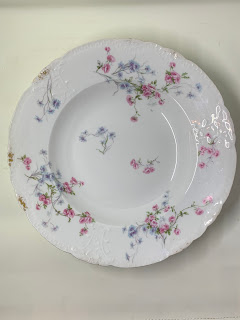

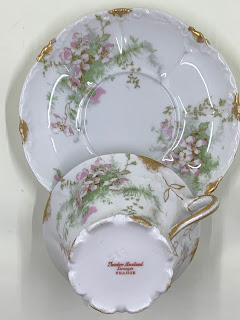
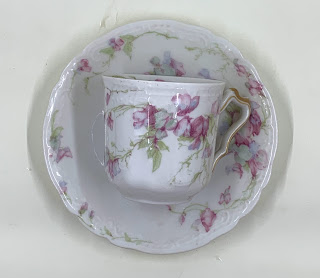
Limoges China
I had thought that Limoges was the name of a company that made china. No, it is the name of a town in France close to the abundant kaolin mines, out of which comes the special white clay used to make the hard paste-porcelain. “Porcelain Limoges is famous for its durability, whiteness, and ability to resist chipping” (limogesboutique.com) and you know it’s real if you can nearly see through it when you hold it up to the light.

“Our” China
Out of the 7 different sets, three are Haviland & Co. and two are Theodore Haviland brands (the 6th and 7th are Zeh Scherzer from Bavaria). I wondered if/how I might be able to identify the patterns and maybe narrow down the timing for when they were produced. I’ve written a couple blogs about some family heirlooms, like my great-great-grandfather’s gift of a pocket watch to my great-great-grandmother, my great-grandmother’s irises, Jim’s great-great grandfather’s trinket, and Jim’s father’s treasured toy car. In each of these cases, I learned a lot and found that there is a collector’s organization for nearly everything! Haviland China is no different!
There is a Haviland Collectors International Foundation (HCIF) dedicated to the study of porcelain and pottery produced by the Haviland companies. They have a newsletter and even an annual conference! They do also have an identification service, but I thought I would try my hand at it. The HCIF does have a very handy guide to Haviland Blank and Decorator Marks.
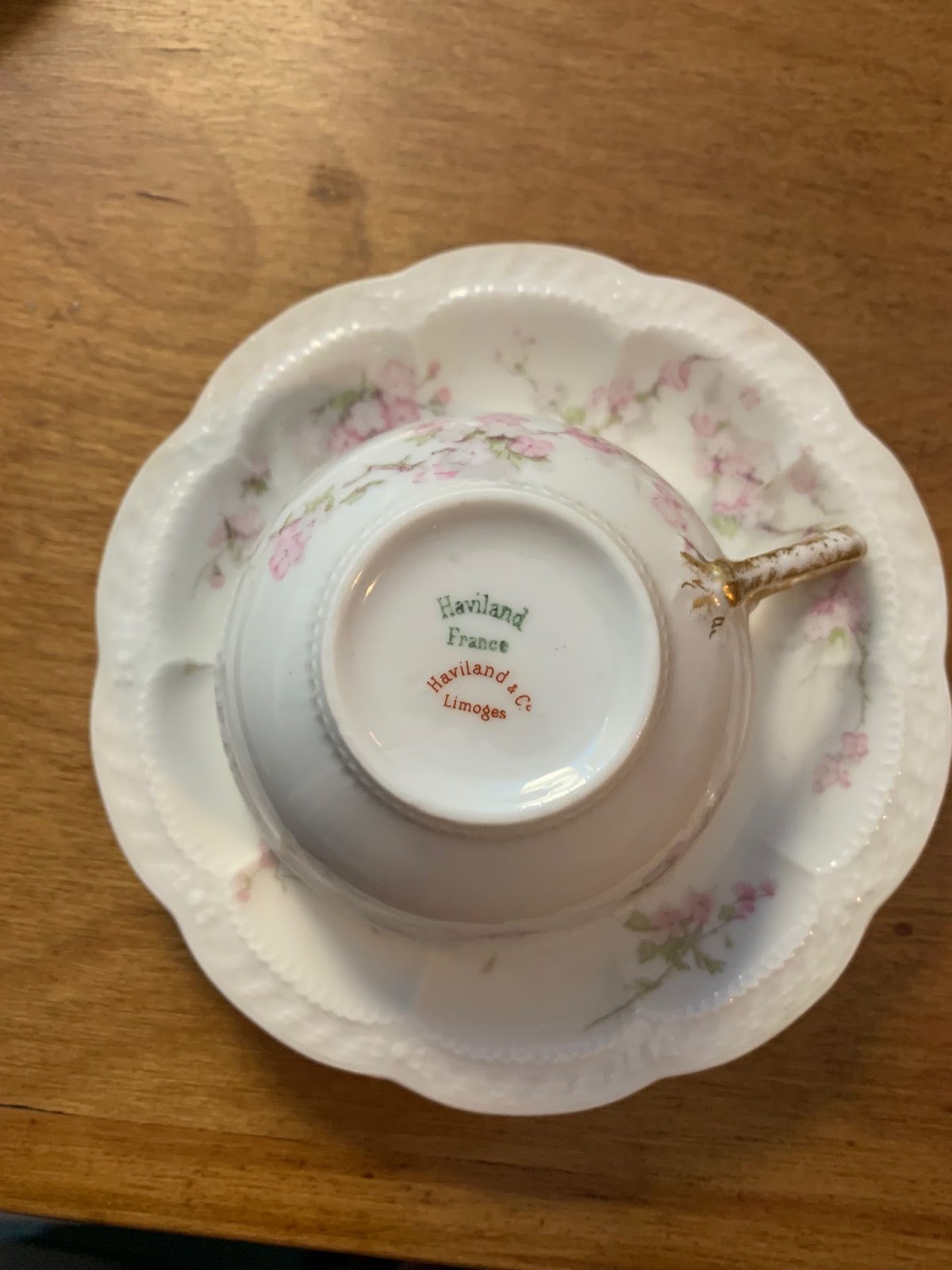 What is a blank? That was new to me, too! The blank is what they call the porcelain item before it’s been fired and painted. Some blanks are plain, but others have a pattern and the size and shapes differ and help to determine the specific pattern. Looking at this photo, this blank is quite decorative, with the scalloped edges and it might be hard to tell, but that shadowed pattern is actually a raised pattern around the edge and into the plate to make it look like petals.
There are two sets of marks (this was not a mistake!), there are marks that are made prior to glazing and then marks made by the decorator after the glazing. You can see here on this cup the green underglaze mark, which is Mark I that was used between 1894-1931 and the red decorator mark, which is Mark c, used 1876-1878/1889-1931. So we’ve narrowed to 1894-1931. Can the flower pattern help us at all in the identification?
Schleiger Numbers
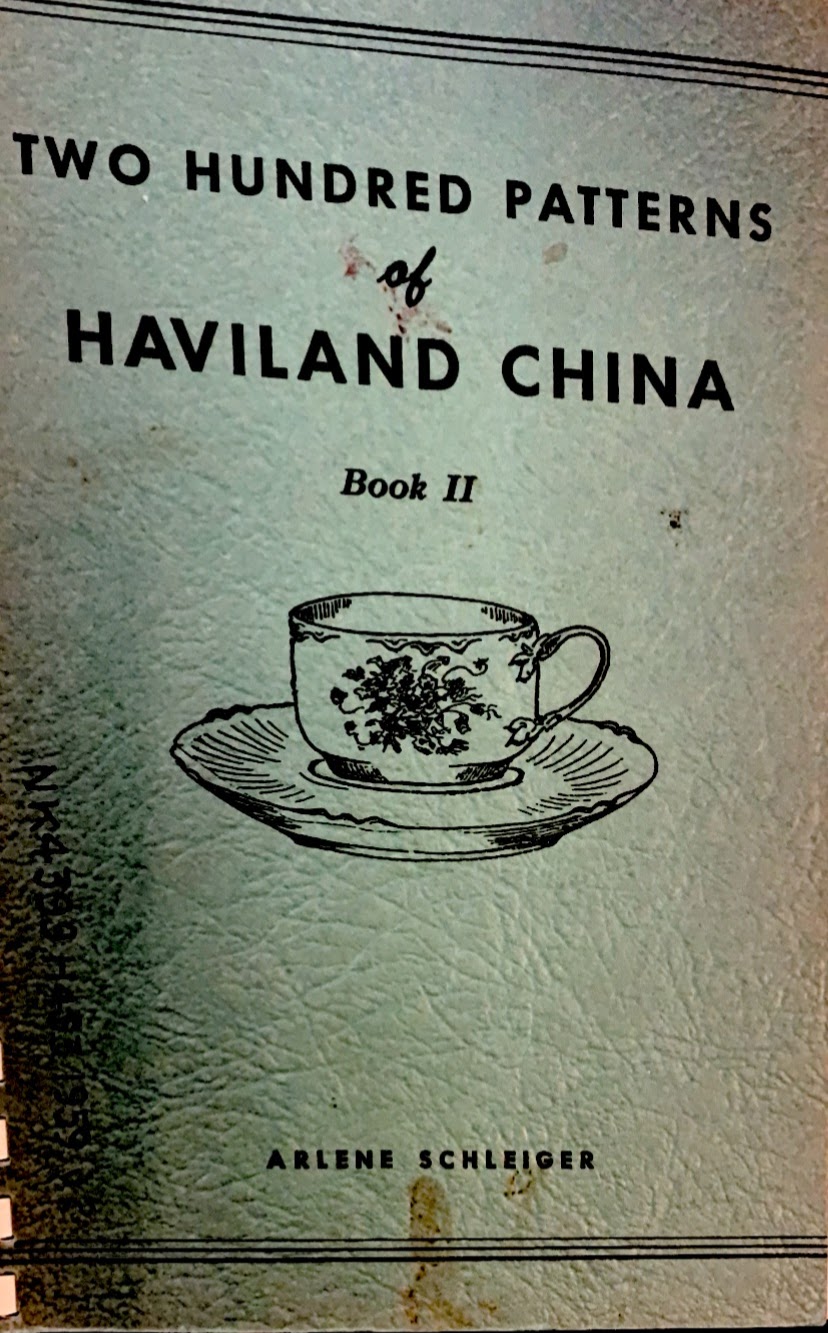
It turns out that there are estimated to be over 30,000 different Haviland China patterns created by the 1930’s and most did not have a name and very few even had a number. According to the A Pattern Identification Guide for Haviland China: Volume Two by Gertrude Tatnall Jacobson (1979) only 725 of the patterns had a name. These 30,000, though, are just variations and combinations of blanks, flower patterns, and use of gold/silver trim. Because there was no easy way to catalog these, an amazing collector, Arlene Schleiger, decided to try to do it. She, with the help of her talented architect son, provided hand drawings and descriptions for nearly 11,000 of these patterns. She produced 6 volumes of these amazing books beginning in 1950 through 1991. One amazing benefit of working at a university is the library collection. It turns out that my university had the first 4 volumes of her books!! Unbelievable luck!


Using her guide, I was able to identify one of the 4 sets. It is a Theodore Haviland set BL 205 (blank #205) Pattern # 248, described “Small pale pink flowers touched with white. Some all white. Green leaves and stems. Gray shadows around flower groups.” (p. 48, Volume II) An additional investigation into the mark suggested S, 1903. (https://archive.org/details/havilandchinavol00gert/page/157/mode/2up?view=theater).
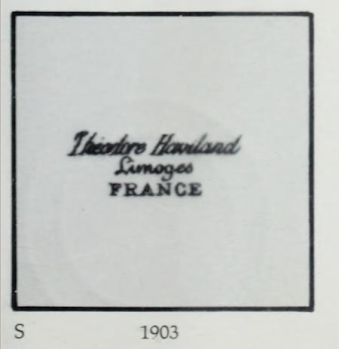
Unfortunately, I couldn't find the other 3.
Replacement, Ltd.
I contemplated joining the HCIF, but thought I would try one other source recommended by the organization. Have you ever broken, chipped, or lost a piece of your everyday plates or your fine china or crystal or sterling and found that it was discontinued? But you really wanted to replace the piece? Well, there is an organization that began in 1981 called..you guessed it…Replacements, Ltd that went into business collecting and distributing replacement pieces. You need to know your manufacturer and then pattern name to really be successful, but once you do their search engine brings up a photo of your item. For example, our everyday plates we chose before our wedding in 1990 are the Poetry pattern from Pfaltzgraf. It was long-since discontinued but if we wanted to, we could replace all of them!

Although I could have paged through all of the Haviland patterns it would have taken weeks! Instead I ordered from Replacements, Ltd the book Haviland: A Pattern Identification Guide (no, our library didn’t have this one, so I invested in the book–I was hooked now). This 577-page book includes photos, pattern names for those that had names, the Schleiger #s and Blank #s. After pouring over the china and the book for just 3 days, I was able to identify two of the other patterns!
So, whose were they?
I am now asking myself, what did this GIANT rabbit hole (and huge investment of time and money) gain me? Am I any closer at figuring out whose they were and how they came to be with my grandparents?
Well, given the Theo Haviland patterns were around 1903 (based on the mark), I am pretty convinced that none of these were wedding china for my grandparents…and I have no idea whose they were…I’m leaning toward the theory that my grandfather just picked up them random places to make the china cabinet look pretty.
But…
Remember how I said that 5 patterns were Haviland and the 6th and 7th was Zeh Scherzer? Well, using my skills in porcelain developed through investigating the Haviland patterns, I think I figured out who these sets might have belonged to.


Zeh Scherzer (Z S & Co) was a porcelain producing company located in Bavaria, Germany that began in 1880. Their marks changed over the years and the mark that we see on our china was used from 1899-1910. I haven’t found the exact patterns (there doesn’t seem to be a collector’s club for this china) but given the timing, I would say that this was perfect timing for my great-grandparents Alonzo Sedlock and Louisa Hillman who were married 18 May 1904. Louisa’s parents were both from German families, her father (Johann Willheim Hillman) immigrating in 1879 from Bremen, Germany and her mother (Emma Amanda Sackman) was born in Germania, Potter County, Pennsylvania but her older siblings were born in Hamburg, Germany (Emma was my last week’s post.). According to newspaper accounts of Louisa in the social columns, she was a socialite and it would not be surprising to me that they were given china for their wedding.
So, I am going out on a limb and conjecture that the 11 plates and 4 cups/saucers and 6 small plates were gifts to Alonzo and Louisa Sedlock for their wedding.
We probably won’t ever know the real story of this mysteriously appearing china but for as long as we own our current house, it’s a beautiful addition to the shelves and I don’t mind using the china for entertaining. In fact, this past weekend, I used several platters for our DAR Special Tea!


 The Probate Record was 82 pages long! I have learned that probate records can vary wildly in what they contain, which depends on the familial circumstances and financial holdings. Henry was not a rich man and didn’t own the home they were living in, but he had a comfortable existence as a bookkeeper for a Copper Mine. The probate record included information about his death (location and date), his executor, friends, will, and lots of purchases made for young Eddie! His personal estate was estimated at $2,300 which in today’s dollars is about $79,000. All of the men that are mentioned are all men Henry knew through his membership in I.O.O.F(International Order of Odd Fellows), which provides camaraderie but also Life Insurance.
 The will was a standard will handwritten by his friend and executor of the estate, Charles Smith just a day before he died. Looking at his signature, he must have had a stroke or something that affected his writing ability because this was clearly not his normal signature. We have confirmation that his son is E.J. (Edward James) and Charles Smith is his guardian. No information about his parents or other family.
 The fun things for me were all of the expenses that little Eddie had in the first couple of years. Clearly nice clothes for a growing boy were important because there were several receipts for new suits, over coat, cap and socks from local clothier L H Richardson’s and a receipt for a suit for Henry from Detroit’s men’s clothier R. H. Traver. (The building does still exist and was renovated for offices.)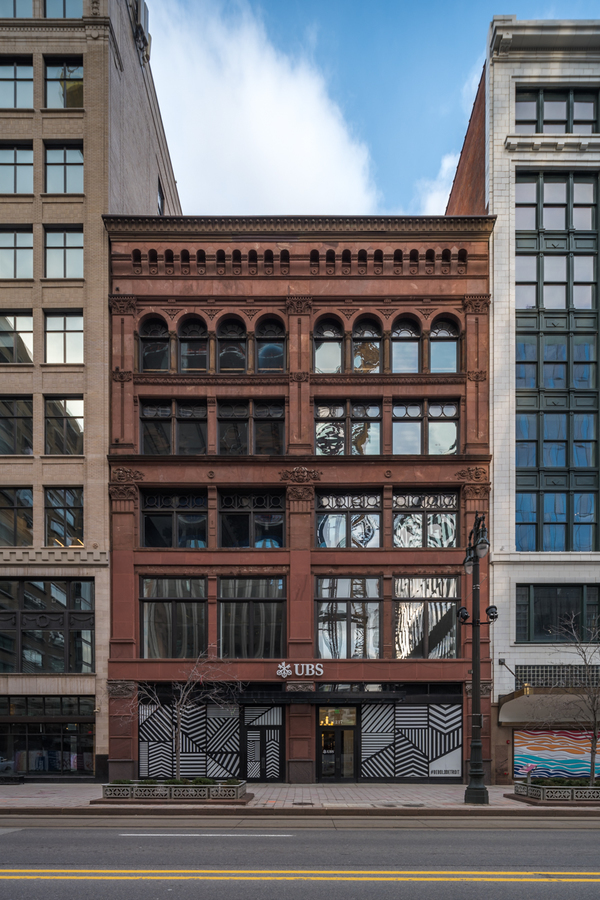


 There were 3 unexpected finds: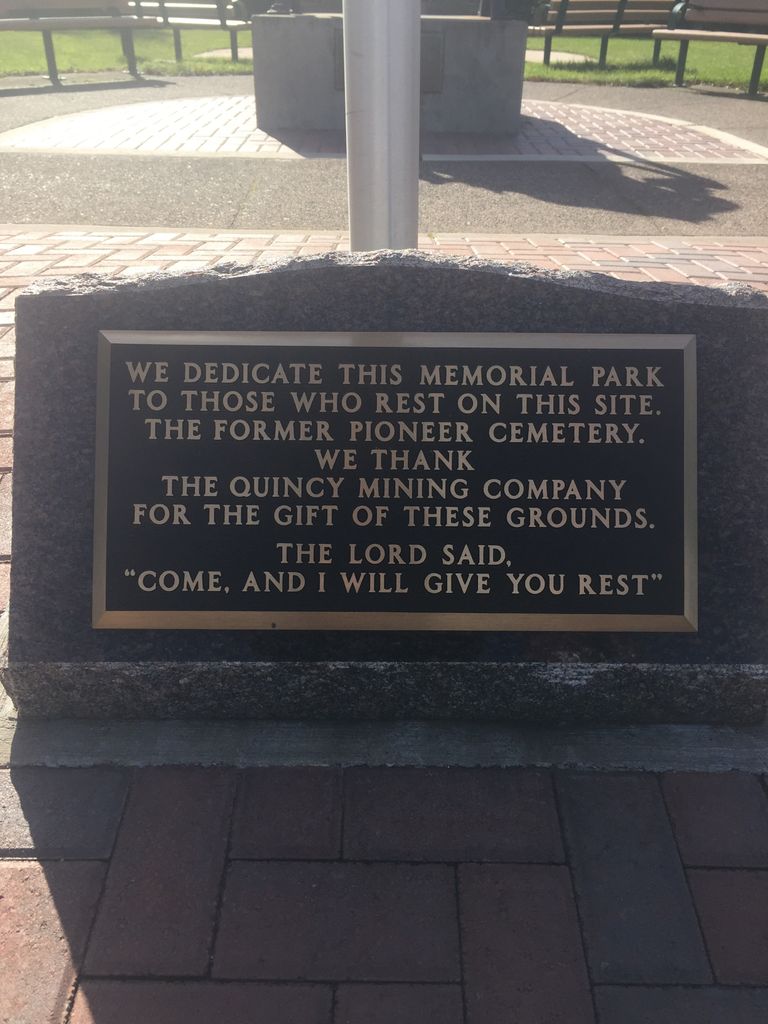




-Enhanced-Color-Restored.jpg)


