Thursday, February 23, 2023

Gem in Indiana...The Allen County Public Library

 The ACPL Library

Last week I spent two incredible days at the Allen County Public Library and when I say two days, I mean two FULL days! Over the 2 days, I was in the library and researching a total of 21.5 hours! The resources available there are incredible and could be a bit overwhelming. On the first day, I chose not to take a break to eat, I just didn’t think I would have enough time. I was famished by the time I returned  to my hotel room and couldn’t make a peanut butter and jelly sandwich fast enough! I learned something. Tuesday, I chose to break for lunch, a great pizza place where I could eat a pizza by the slice, and felt much better late afternoon and early evening. This was a GREAT practice for my weekly long visit in the Salt Lake City Family Search Center, starting Tuesday!!


The true treasure though are the research librarians!! They were amazing and everything is FREE. If you ever go, I highly recommend that you make an appointment ahead of time for a consultation and share with them ahead of time your research question and goals. I started my first day at 10am with a meeting with Sarah. Sarah was assigned to me because she specializes in the midwest. She had done lots of research ahead of time and provided me with a printed list of suggestions specific to me and we went over it together. She acknowledged that my brick wall of Henry Edward Leach was truly a brick wall and I felt a little bit better that a professional acknowledged that this was a hard one. She then gave me a tour of the library and set me up with my first task of searching the microfilm for the death records for Henry. 


You can have your own book cart!! That was so cool and I really learned how to best use my brand new scanner.


My First Brick Wall


I didn’t end up finding out much about Henry, although I chased down a lead given to me by Sarah that  might end up netting something in the future. Sarah reminded me about the FAN Club Principle in Genealogy. This concept was developed by Elizabeth Shown Mills, a guru in genealogy, and it’s simple but very effective. FAN stands for family/friends, associates, and neighbors. If you are ever stuck, you might find leads in the FAN Club. 


Sarah suggested that I look to the people who hosted the Boarding House that Henry Edward Leach was living at in the 1880 census, since it was reported that he was from England and so were the owners of the boarding house and one of its other boarders. She reminded me that it is possible that there was a connection among them or that they knew each other in England or knew people who knew them. It was a great thought and although I don’t think there was a connection, it heightened my awareness of the boarding house owners for later reading! I came across a photo and some background of the couple and gave me a better understanding of where Henry was living in 1880.


Other Cool Stuff

After those first 4 hours, I chose to turn my attention to other parts of Jim and my family trees. I found several plat maps that show various family members' farms...like the Tubbs farms in Washtenaw County (my side) or another the plat map that identifies where Jim's great-grandparents had a farm in Crystal, Michigan. It's always cool to see the relatives' names on these maps. (Peter Monroe Baucher is my my husband's great-grandfather and his property is in the right side of the NW corner of section 7, just above and to the left of Crystal Lake.)

I also found a not so old...1986..Sesquicentenniel Celebration book of Three Rivers, Michigan complete with a Prophecy for 2011. What was amazing is that one of the students who was making the prophecies is a woman that Jim and I met while studying abroad at the University of Aberdeen (she was another American!!). We don't think of ourselves making history, but we are! Makes you wonder what remnants we will each leave behind for future generations to find.
The Mayflower Society

Another goal I have during this year is to solidify the connections to hopefully submit an application to the Mayflower Society. I’m doing this as a genealogical challenge. 


If you think you have a line that goes back to one of the original 26 families of passengers on the Mayflower, I suggest starting with the Silver Books. They provide all of the proof for the first 5 generations of descendants from the original 26 families with descendants. (There were actually 106 passengers on the Mayflower, but over 50% died in the first winter and only 26 families had descendants that lived on.)  I had used the Silver Books at the DAR Library in DC (anyone can use the library, you don’t have to be a member) to investigate the two lines that I think I descend from. 

The Book that provided the connection
between the Walkers and Orcutts.


The ACPL has an amazing collection of Family Histories and I was able to find a book that provided to me the confirmation and link I needed! Now I “just” have to find copies of all of the birth, death, and marriage records. That’s part of what I am doing at the Family Search Center now!


Highly recommend the ACPL and I definitely think I will be back!


Sunday, February 12, 2023

An Unplanned Excursion Worth Taking!

 Anyone who knows me well knows that I'm a planner. I'm detailed and goal oriented. I make a plan and I follow it! I have learned to deal with ambiguity, but I prefer a plan.

Today, I knew the route I was taking to get from Riverside, PA to Ft. Wayne, IN. I could have taken a route I know well, it was 3 minutes faster but it was along I-80 and had tolls. But I chose to take the alternate route and that was my plan. It was a direct shot to Ft. Wayne and I didn't plan any site seeing along the way.

The Excursion

Me in front of one set of Jim's
Great-Great Grandparents Graves
As I was half-way through Ohio, and not on the part of Ohio we normally travel to Michigan, I realized that Molly and I might just be passing close by a cemetery where my husband's family was laid to rest. Since I was driving and couldn't do this on my own, I quickly called Jim, who happened to be talking with one of our daughters and I asked them if they could help navigate me to the Liberty Chapel Cemetery in Liberty, Mercer Co, Ohio. (I really marvel at technology and what we can actually do on the fly, I do love the time we are living in!)  They did and I altered my route and drove about an extra hour today that I hadn't planned, but I had the time and it was worth it!

Background

Peter Monroe Baucher &
Mary Lucinda Howell
Jim's maternal great-grandparents, Peter Monroe Baucher and Mary Lucinda Howell were both born in Ohio. Mary was actually born in Liberty, where the cemetery is located. They both came from farming families. Peter's grandfather's family originally came from Pennsylvania (Bachar) slowly moving westward into Ohio. Peter was the 11th child of 12 and his father died when he was 10. He grew up farming, which is what he knew but by the time he was married (1892), there wasn't much farm land to be had. He worked as a blacksmith (according to 1900 census) and then sometime before 1910 found farmland to buy in Crystal, Montcalm, Michigan and was a farmer until he died in 1930. Mary Lucinda was from a Howell farming family that had been in Ohio for many generations.


Find-A-Grave

I love Find-A-Grave and have taken and uploaded hundreds of photos to it about my family and also from our local cemeteries. In fact, early during COVID, one of my daughters and I spent weekends in cemeteries around our local area finding and photographing gravesites that people had requested. In those early months when people were afraid to get out of their houses, it was a great way for us to get out of the house but go where no living people would be and do something for others. I love these crowdsourcing websites where people can help other people find their relatives. I highly encourage everyone to do this, even if they aren't into genealogy. (And there are other sites like Billion Graves).

The Headstones

Both sets of their (Peter Monroe & Mary Lucinda) parents are buried in this cemetery. I knew that and I actually already had photos of their headstones, thanks to Find-A-Grave, but there is something about actually being physically in that space. Driving out there and seeing the Ohio farmland all around. The town of Liberty has less than 1,000 people and quite honestly from what I saw, I have no idea where they all live! At some point, I imagine there was a church (or at least chapel) next to the cemetery but there's no sign of it now and it seemed like about 1/3 to 1/2 of the people buried in the cemetery were related to these two. While I didn't actually learn anything new, it was interesting to see that someone is still caring enough for the graves to put out a wreath. I'm sure there are relatives of Jim's still in the area. I don't have any photographs of these four great-great grandparents, YET, so maybe one day I will connect with a descendant of one of Peter's 11 siblings or one of Mary's 10 siblings who may have a photo of their parents?!


Saturday, February 11, 2023

Molly and Me--Ready for an Adventure

And we're off! 

Molly is my car. She's a Malibu and she is all set and ready to go. She's all packed up, ready for our morning adventure. 

Our first stop is the Allen County Public Library in Ft. Wayne, Indiana. Some people find it odd that some county library in the midwest would have incredible holdings of genealogy. There was a generous benefactor who was a genealogist and cared deeply about it. His legacy is this amazing free resource. I have an appointment with a genealogy librarian at 10am on Monday, who I have prepared with a research question and as much information I have on this person and what I hope to find. I will spend 2 days (10am-8pm) in the library and I'm excited!!

The Practice Run

My practice run to the Westchester County Archives last Wednesday went well and I learned some things.


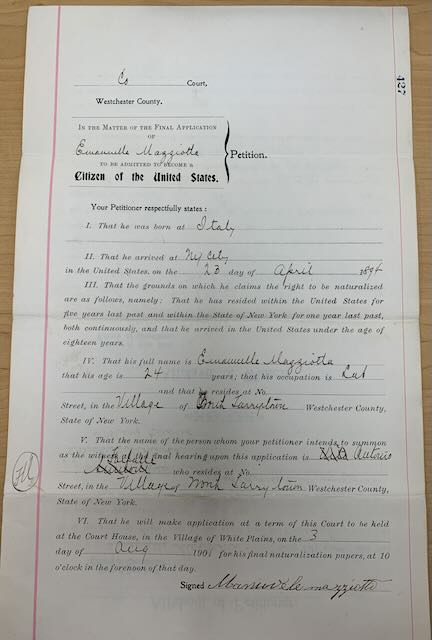
And also *think* that I found the Naturalization Records to my great-grandfather, Emanuel Anthony Mazziotti. The reason that I say *think* is that there is some conflicting information that raises more questions!! (I'm learning that this may be a theme).

If this is him, he was naturalized on August 3, 1901. It didn't provide a street address for where he was living, just "North Tarrytown", which is likely to be Pocantico Hills, where Kykuit (Rockefeller's Estate) is where I believe he was working at the time. It was amazing to be holding the actual original paperwork that my great-grandfather held in his hands and signed his name! It's hard to tell from the photos but the naturalization paperwork is folded in half and then folded into fourths. I almost missed that it had been folded in half and that there was an inside to it!! The length of the paper when folded in half was approximately 8.5" x 14".


The Outside of the Naturalization Petition
 I learned also that this is a "Minor Alien" petition. These were issued for anyone under the age of 21 when they first arrived to the country. (Naturalization Act of 1906 changed rules and also the forms. They became more specific and included the ship name and other family members.) 

One of the reasons that I am doubting if this is my Emanuel Mazziotti (beside the name of Mazziotta) is that he had to have been in the country continuously five years from the time of first arrival before this petition.

The "Back" side of the Naturalization Paperwork
We have "evidence" that suggests that he was in the Italian Calvary from 1894-1897. And I know that he arrived in 1900 on the Tartar Prince.

So there are 3 possibilities:
The "Inside" Top
  1. This is not my Emanuel Mazziotti
  2. Our evidence is wrong and the time frame must have been different about when he was in the Italian Calvary
  3. He mis-identified when he arrived.
While it is possible that this is not my Emanuel, his witness was an Antonio/Antonino Farfalla. In 1910, there was an Antonio Farfalla living with my great-grandfather and he was his brother-in-law.

In talking with the archivist and sharing my conundrum, she said that it was not unheard of at the time that if they had a "sponsor" that that person would help along the naturalization process. In those cases, sometimes people would lie about the date they arrived to move along the process.

Both my daughter and I searched and search the ship's manifests for the date he said he arrived and we didn't find a Mazziotti (or any permutation of the name) who arrived that day or in the following week. 

At this point, my hypothesis is that this is my great-grandfather and lied (gasp) about the date he arrived. But, I have more to investigate and will withhold complete judgment until I do.

Meanwhile, I'm happy with what I learned about archival research at the archives (mechanical pencils are NOT okay!) and also with a second page to his marriage record. (Note the spelling of his name and I *know* this is my great-grandparents' marriage record.)


The "Inside" Bottom


What's Next?

My first brick wall! I'm going to do a thorough search at the ACPL on Henry Edward Leach. Looking forward to seeing what I learn and what paths it may take me on!


Tuesday, February 7, 2023

Names and Naturalization


Top: Mary Anne, Florence Mary
Bottom: Mary, Mary Grace

Names and calling people by their preferred name is important to me. Maybe it is because my given name and what I prefer to be called are different. I was born Mary Lynn Massey. I like(d) my name and am happy with “Mary”. I come from a long line of “Mary’s”, there’s my mom, Mary Anne, my great-grandmother Florence Mary, my great-great-grandmother Mary, and my godmother, Mary Grace Mazziotti Sippel.  And as proud as I am of Mary, that’s not what I liked to be called. I prefer to be called “Lynn”, I suspect it’s because it’s what my parents always called me, except, of course, when my mother was unhappy with me and then she called “Mary Lynn!” But it was always important to me that people call me “Lynn”, so every year on the first day of school we went through the routine as the teacher was calling names on the attendance list.


   Teacher: “Mary Massey?” (chuckles from knowing classmates)

   Me: “Here, but actually I prefer to be called ‘Lynn”.” 

   Teacher:  “Lynn?” 

    Me: “Yes, that’s my middle name.” 

   Teacher: “Oh, Okay.” (Thank you.)

  It’s actually quite a great screening mechanism and useful when telemarketers call. “Is Mary there?” “Nope, no one goes by that name here! Goodbye.” click.

Calling people by the name they asked to be called, I think, is a sign of respect, caring, and honor. As a teacher/professor, I want to get the students’ names correct and always ask them to share their preferred name and correct me on the pronunciation. I also really appreciate doctors' offices and other places where my legal name appears but they care enough to call me, Lynn.


But while I respect calling people by their preferred name, it sometimes makes researching the family records difficult!! I know that when I’ve performed a search on myself, there are over half a dozen different names recorded–Mary Massey, Lynn Massey, Mary Lynn Massey, Mary Breyfogle, Mary Lynn Breyfogle, Lynn Breyfogle, and even M. Lynn Breyfogle! I will just apologize now to my descendants who might be interested in researching me! Sorry!


Naming Traditions and Conventions


Names continue to fascinate me. Naming traditions and conventions and how that has changed over the generations and differs by cultures is interesting, especially in genealogy work. When you learn some of the naming conventions it CAN be helpful for family history work. 


For example, in Italy (and many early Italian immigrants), there is a methodical way of naming children. The first male and female children are named after the paternal father and mother, respectively. The second male and female children are named after the maternal father and mother. After that, it is the parents (although if the father was a first-born, that name was already taken) or  it could be aunts/uncles/cousins/friends. Since mortality rates of children were high, if the first child named after a particular grandparent died, the next child born would have that same name (this is called necronymics). So, you could imagine that the order of the named adult children will not be “perfect” and you have to watch assumptions that you make…but the naming order is a general rule you can use in Italian families. This explains why there are so very many Rocco Bellantoni’s! (For more read June 2005 Family Tree Magazine).


For German family trees, I recently learned, the reason that I find so many Johannes (John) is that German boys were almost always baptized with the first name of Johannes! They rarely used their first name and always had a second name, so they were called by their second name. The same held true for girls, except they were usually baptized with Maria (Mary) and then called by their second name. I guess my name fits well in a German family tree! (For more read the September 2012 article in Family Tree Magazine).


I love to hear the stories around peoples' names. Who were they named for, or even If they were named after someone. I often ask students about their names and love hearing their stories. This past fall, I met a student whose family immigrated from Ghana. Her surname was Appiah-Padi and I know someone with that same last name from Ghana, so I asked her about her name, wondering if there might be a connection. She was happy to share with me that in her culture last names are also given to the baby in honor of other people chosen by the parents. She doesn’t share a surname with either of her parents or grandparents! Neat tradition, but wow…that might make the genealogical research much harder. I will stop complaining about how many Giuseppe Mortelliti’s there are in my tree!


Naturalizations


Well, speaking of Giuseppe Mortelliti, that brings me back to my finding this week! This Giuseppe is my great-great grandfather and he immigrated to the US from Scilla, Italy and is the father-in-law of Emanuel Anthony Mazziotti (aka. “Mystery orphan baby”). One of my research goals for the year is to find the naturalization records for Emanuel Anthony Mazziotti (and Giuseppe). I have been searching on and off for YEARS to find Emanuel’s naturalization records. 


His name is part of the problem. I learned two summers ago that his name was just made up by the Recording Clerk in the commune where he was found as a baby. He has no known siblings, no one else that shares his last name or first name, until you get to his children and grandchildren. My dad called him “Pop” but said that he was called Tony or Anthony by family or friends. Emanuel is spelled many different ways in different documents and sometimes paired with Antonio or Anthony. Sometimes he appears to be recorded as just Antonio/Anthony and his last name is Mazziotta or Mazziotti and in the 1910 census, which took me decades to find, he is listed as Antone Martin!! (Yep, absolutely positive this is him!).


My husband has asked me this week why I care about the Naturalization Records? What did I hope to find that I didn’t already know? I stood dumbfounded and couldn’t find words. He said, “Well?” Oh, there are so many reasons..but you are reading this blog so YOU probably understand.


Naturalization records are complicated to find because there are so many factors. The U.S. Citizenship and Immigration Services website sums it up: 


Immigration and nationality records changed over time. For this reason there is no one set of instructions to guide family history research. What records exist and how to find them depend entirely on when the immigrant arrived and if, when, or how they became a United States citizen.” (bold added by me)


One thing that the Naturalization records help to find is the immigration date. I actually already know that for Emanuel. I found the ship manifest and records of his entrance (and a travel companion, his future father-in-law Giuseppe Mortelliti) into Ellis Island years ago, but his path to becoming a naturalized citizen has eluded me. Some facts I “know” about Emanuel:


  • He arrived May 28, 1900 to New York from Scilla (via Naples) and reported that he was going to live with his “father, Rocco” at 168 Elizabeth Street in New York City. (If you have any Italian relatives or are just interested in immigration stories, Laurie Fabiano’s 2006 book Elizabeth Street: A Novel Based on True Events is a must read!) 

  • Emanuel & Concetta Mazziotti
    February 9, 1908

    In 1903, he married Maria Mortelliti (Giuseppe’s daughter) at Church of the Magdalene in Pocantico Hills. (Note: Maria died after giving birth to Rocco Mazziotti, who also died as a baby. Emanuel ends up marrying Concetta Mortelliti, the younger sister in 1908 and they end up celebrating 55 years of marriage and 7 children who all lived fruitful long lives.)

    This was taken at their 50th Wedding Anniversary
    1958

  • The 1905 New York Census is missing pages and I have searched but can’t locate Emanuel there. I see a neighbor from the 1910 census on the last page before a break…I’m guessing he’s on the next (lost) page!

  • The 1910 US Census identifies Emanuel (and Giuseppe) as “Aliens” working on the Rockefeller Estate (Kykuit) in Pocantico Hills, a hamlet of Mt. Pleasant in Westchester County, NY. 

  • The 1915 NY Census identifies both as  “Citizens” with Emanuel (a mason) and growing family living on Saw Mill River Road and Giuseppe (called Antonio Martello) on Hartzdale Rd. both in Greenburgh (Elmsford) in Westchester County, NY.

  • The 1920 US Census identifies that Emanuel  is “Naturalized” and the date given was 1902! Giuseppe had passed away, but his widow Santa Morabito Mortelliti is listed as Naturalized also with the date of 1902.


If you were reading closely to the facts, you see a big conflict. If, according to the 1920 census he was naturalized in 1902 then why did the 1910 census say he was an alien? Well, anyone who knows about self-reported data and the Census takers, knows that while everyone tries to give accurate information we are all humans and errors are made (and sometimes white lies). Especially when the information is provided by a person with a thick accent who may not be understood by the census taker or who may not have understood the question! 


Ancestry.com and FamilySearch both have indices for finding naturalization records. I’ve looked and I can’t find any permutation of his name. This past week, I decided to focus on really searching. If I take my dad at his word (who told me the family lore is that he became a citizen in 1902) and the 1920 Census as accurate, then I should focus on pre-1906 Naturalization record finding techniques. Which is …for New York, go to the county records. Again, I made an assumption that he was in Westchester County, rather than looking to New York City.

Long story short… I have found the index through the Westchester County Archive page and among the listings (after painstakingly going through year by year), I have found the index Petitions for Naturalization for BOTH Giuseppe Mortelliti and Emanuel Mazziotti. I’m not quite sure why there are two files for each of them, but what were the names?

  • Emanuel Mazziotta

  • Manuele Mazziotti

  • Giuseppe Mortellite

They don’t have the records available for viewing on line, so Wednesday (tomorrow!), I have an appointment with the archives and will be driving the 3 hours there and back to view the actual documents!


Fingers crossed that the Emanuel and Giuseppe in the index are actually them….and they tell me some tidbit of information that I didn’t already know. But if it is them and I don’t learn anything new, that’s okay, the search was worth it and I can check off that box and move on to the next research goal for the year! Stay tuned…I might have something to say later this week. 🙂


Monday, January 30, 2023

“Notions and Fancy Goods”, Jobbers, and Heirlooms


This is me with my great-grandmother, Florence Mary
Stoddard Leach (c. 1973). I am called Lynn, but my first name
 is Mary, named after my mother, her grandmother,
and her great grandmother, Mary Bedell Stoddard.
In the fall, as I was cleaning one of my bureau drawers, I came across a small collection of heirloom pocket watches I have been entrusted to keep safe. They are all originally from either my great-grandmother, Florence Mary Stoddard Leach, or her parents, Henry Clay and Mary Bedell Stoddard.
Florence Stoddard, (unnamed seamstress), and her mother Mary Bedell Stoddard
in front of their home in Reed City, Michigan (c. 1905)


    One week, after listening to a GenealogyGems Premium Podcast (199) Heirlooms–Capturing their stories and passing them on, I was inspired to really look at these watches. I gingerly figured out (with Jim’s help) how to open them—did you know that it kind of opens like a butterfly and has an inner cover that can be inscribed? Well, one of them is inscribed…it says “Mrs. H. C. Stoddard from Her Husband. Dec. 25th 83” (Obviously this is 1883, not 1983– they were married in 1872).

    How sweet, I cried! I was overwhelmed with emotion as I held this pocket watch that was almost 140 years old my great-great grandfather, Henry Clay Stoddard, had given to my great-great grandmother! On the inside front cover was a photo of my great-great-grandmother, which I hypothesize my great-grandmother put inside so that she could have her own mother close to her heart after her mother passed away in 1909 (my great-grandmother lived until 1974!).


    I have created a googleform to catalog the family heirlooms and I plan to catalog most of the family heirlooms this year. I would like a photo to go along with each description (of course!), so I asked for a ShotBox for Christmas so that I can take professional looking photographs with good lighting without shadows (hard to do in my Victorian House!). It wasn’t a beautifully inscribed pocket watch, but I love the fact that my husband shows his love for me by supporting me in this crazy hobby! Thanks, honey!


    One thing that the special guest on GenealogyGems podcast shared was the importance of including background information, whatever you know and can find about the items. The companies that made the heirloom can be interesting in and of themselves! (I know, just one more thing to research, but the rabbit holes are fascinating.)


    Pyrography of Gibson Girl by
    Edward James Leach (bef. 1919)

    This week, as I was packing something up in the guest bedroom, I looked to another heirloom hanging on the wall. It is a woodburned wooden plaque of a Gibson Girl, my grandmother identified as something her father EJ Leach (Florence's husband)
    Edward James Leach

    had made. It was not my intent to sit down and catalog this heirloom at that very moment, but I was intrigued. Because my grandmother had written “Gibson Girl” and “woodburning tool” on the back, I started by googling those words. 
    Saturday Evening Post Advertisement
    • I learned that woodburning is actually a craft called “pyrography” (maybe you already knew that?!) and have done some of your own during the 1970s craze. 
    • I learned that the Flemish Art Company in New York held the market on creating pyrography kits
    and that they tool all forms, wooden boxes, wall hangings and even leather items. In my search,
    I came across an article about a 91-year old collector of Gibson Girl pyrography she’s found in antique stores and e-bay. 
    (Thanks to Google Books)  Okay, it took me a moment to figure out what this meant and who the audience for this journal would be! Maybe you ready know what a “Jobber” is? Or maybe you know the contemporary meaning? But in 1903, a “Jobber” would be a wholesaler or distributor. Learn something new every day!

    1904 Issue of Notions and Fancy Goods

    I think my great-grandfather did a great job with this project and I appreciate that I have learned something more about him and the craft of pyrography. I know this was a “kit” and I can not yet be certain that it was put together by the Flemish Art Co, but I’m tracking down leads and imagine someday I might even find a picture of the kit in some catalogue for Jobbers that has been digitized!


    Friday, January 20, 2023

    A Picture is worth MORE than a 1,000 words!

     Anyone who knows me, knows that I love pictures! 

    I love taking pictures (my kids know this all too well!), looking at pictures, scrapbooking about pictures, collecting pictures, sharing pictures, and including pictures of people and places in my family trees.

    Our daughters, they still laugh like this when they are together!
    Having photos of my family (and my husband’s family) is important to me. The names and dates and even stories about people just don't “bring them to life” like a photo does. Last year, I made it my project to decorate our upstairs hallway with a family tree of photos. (It wasn’t my idea, I used
    this blog to guide me). I love walking by it every day and seeing the people who made Jim and I who we are. But I also recognize that just one photo of a person is not enough, because one quick moment in time can’t possibly give a sense of who they were as a person. Pictures may be worth 1,000 words, but a life can never be summed up in one photo!


    About 25 years ago, my search for old family photos truly began. 

    It wasn’t intentional, it was “just one of those things”. My dad and I were at the Hitching Post Antiques Mall in Tecumseh, Michigan (close to our family cottage). We were both drawn to the postcards and we just started looking through the Michigan and Sand Lake Collections (n.b. there are two Sand Lake’s in Michigan) and I found a postcard of this photo. It was labeled “Opening Day, 1907”.

    Lodge Hoowanneka, Opening Day 1907, Sand Lake, Lenawee County, Michigan
    While it’s a fun picture, it has so much more significance! The sign on the cottage says “Lodge Hoowanneka”, which is the name of our family cottage on Sand Lake!! It was one of the first really old photos I saw of our cottage. We since have found many more, but finding this at an antique store gave me the desire to look for those proverbial needles in a haystack and I have been sifting through old photos and postcards at every antique store I can get to, looking for anyone or anything connected to my husband or my family.


    I also started using a variety of on-line tools. 

    (Now they are plentiful, just see the recent FamilyTree Magazine article that outlines 13 really amazing repositories of photos. Ancestry.com and myHeritage are there, but there are lesser known ones like DeadFred and Digital Public Library of America. Warning–you will tumble down the rabbit hole!) 


    Post on Genealogy.com Surname Forum
    In 2010, one of my first amazing finds was this one of my great-grandfather, Edward James Leach, when he was a student at Olivet College (1901-1902). (This is where he met my great-grandmother, she was also attending Olivet College.) I don’t remember exactly how I ended up at genealogy.com where they host surname forums, but I found a post from 2003 by a genealogy angel who said she had a photo of Edward Leach. I contacted her and she sent me a beautiful print (for a price). I later found out that she did this as a business, she owned an antique store in Northville, Michigan.
    L: Bartley Thomas, T:Howard Ellis, B: Edward Leach, R: Maurice Jones
    Olivet College, c. 1901

    Paying it Forward

    This experience planted a seed that continued to germinate as I went to antique stores. 

    Over the years, while I haven’t found a whole lot of our own families, I asked myself, wouldn’t I appreciate, and be really surprised, if someone looked through antique stores and shared with me a photo of one of my ancestors? So why don’t I become one of these genealogy angels who connects old photographs with their descendants? I look for semi-identified photocards, my favorite time frame is 1880s-1910s, research the people and then try to build out trees to people who might be living now. I didn’t keep track at the very start, but since 2013, I have been successful in connecting nearly 50 photos. I don’t charge a fee, I tell people, this is truly my hobby and joy to reconnect them with family who will appreciate it. 


    I have two favorite picture/stories from this experience so far. One was from an 84 year old woman, Rowena, who wasn’t directly descended from the adults in the photo, but she personally knew all of the people in the photos because they were cousins. She had never seen any of these photos and was truly thrilled to own them and share with family. A second, Dave, was so excited by my find of his grandfather that when he received it, he took the photo and put it next to the 50th anniversary photo of his grandparents and sent it back to me to show me the resemblance. Some day, I’m hopeful that someone does this for me, but in the meanwhile I will just take joy in those that I connect with others!

    Rowena's cousins

    David's Grandfather

    What made me think of this today?

    Well, last night watching Lisa Louise Cook’s Elevenses with Lisa episode from 1/13/23, she shared a new-to-me resource, ArchiveGrid. This is an amazing free platform brought to us by the same people who created WorldCat. Everything in an Archives can’t be digitized, there just isn’t enough time (I saw for myself this very fact in the Bucknell University Archives today!) but ArchiveGrid is a catalog of the holdings in Archives around the world (yes, not just the U.S). I tested the waters last night and BINGO!! 


    In a collection at the Bentley Historical Library of the University of Michigan, they have a file called, “Genealogical Society of Washtenaw County photograph collection” that contains 5 envelopes and in them includes two exciting finds. The first is a photo of the family home/farm of Samuel Obed Tubbs (1834-1917), my great-great grandfather! Samuel Tubbs was married to Francis Eliza Randall (1837-1924), who is the daughter of Timothy Castle Randall (1806-1849).

    Francis Eliza Randall (1837-1924)
    my great-great grandmother


    Samuel Obed Tubbs (1834-1917)
    my great-great grandfather

    The collection says that it includes photos of Timothy Randall’s children and grandchildren. It doesn’t identify who exactly, so I’ve asked for all of them! They aren’t digitized so I haven’t actually seen them, but they are ordered and I will patiently (or not so patiently) wait the 6-8 weeks while they digitize them. Jim said I could just wait until the summer when I am at the lake and go myself….clearly I’m not THAT patient! 


    This won’t be the last time I blog about my photos or finding them, I am certain!

    In the meanwhile, wishing you lots of luck finding your own treasured pictures worth more than 1,000 words. 


    America250-Revolutionary War Patriots --#6--Lt. Caleb Hopkins

    Jim’s 5th great-grandfather, Lt. Caleb E. Hopkins (1749-1824) DAR (#A047932) served as a Lieutenant Revolutionary War Patriot.  He was the s...